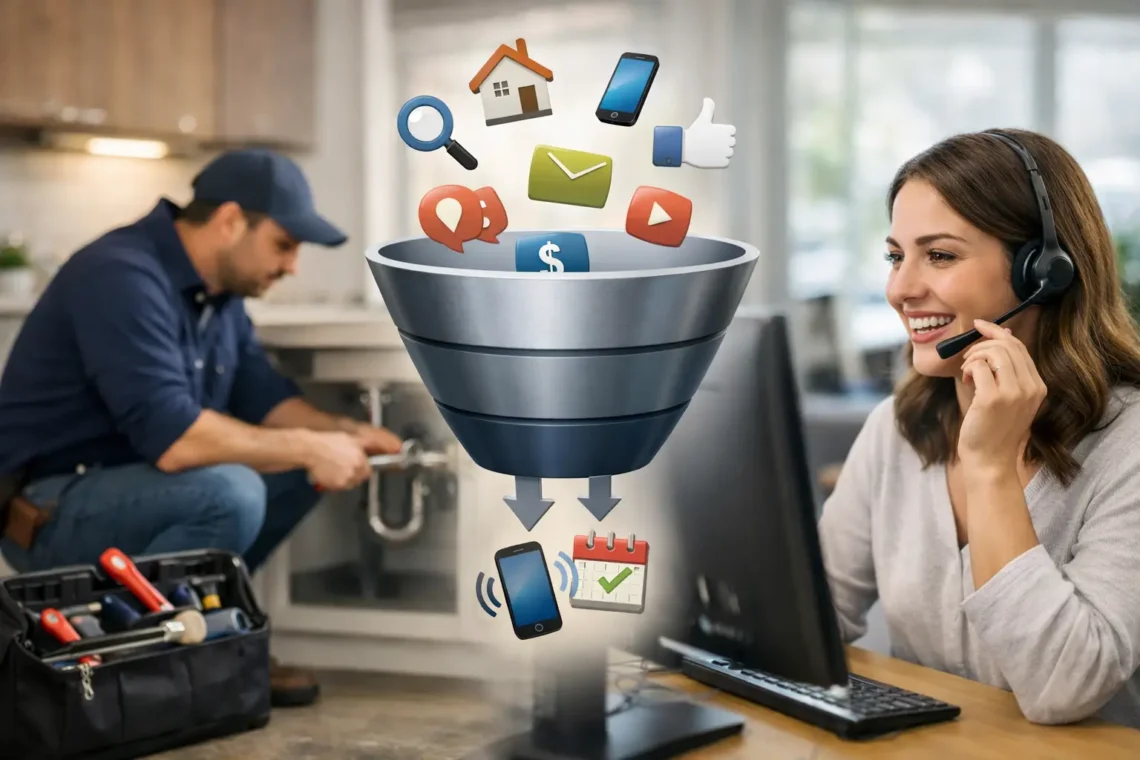
Home Service Marketing Funnel That Books Calls
A lot of home service companies do not have a lead problem. They have a conversion problem.
For a related guide, see our article on Florida Home Service SEO That Brings Calls.
They get some website traffic. Their Google Business Profile shows up here and there. A few people call. A few fill out a form. But the flow is uneven, and the jobs do not come in at a pace you can count on. That is where a home service marketing funnel matters. It gives structure to how strangers find you, trust you, contact you, and turn into booked jobs.
If you run an HVAC company, plumbing business, roofing company, or another local service business, the goal is not more random traffic. The goal is more qualified calls and appointments from people ready to hire now.
What a home service marketing funnel really is
A home service marketing funnel is the path a customer takes from problem to booked appointment.
For a local service business, that path is usually short. Someone notices a leak, a broken AC, roof damage, or a clogged drain. They search Google. They compare a few options. Then they call the company that looks trustworthy, local, and easy to reach.
That means your funnel does not need to be complicated. In most cases, it has four parts. First, you need visibility when people search for your service. Second, you need trust signals that make them choose you. Third, you need a clear way to contact you. Fourth, you need follow-up so leads do not get lost.
Many owners overcomplicate this. They think they need every channel, every app, and every trend. Most do not. A simple funnel built around high-intent local searches will outperform a messy marketing setup almost every time.
The best home service marketing funnel starts with intent
The strongest leads usually come from people already looking for help. They are not browsing for entertainment. They are searching terms like plumber near me, AC repair in Tampa, or emergency roofer.
That is why the top of your funnel should focus on search visibility, not broad awareness. If your business shows up in Google Maps, local organic results, and branded searches, you are meeting buyers at the exact moment they need you.
This is also why a lot of social posting does not fix the real problem. It may keep your brand active, but most homeowners are not scrolling social media hoping to find a drain cleaning company. When they need service, they search.
For most small local businesses, the funnel should begin with these assets working together: your Google Business Profile, your website, and your local service pages. If those are weak, the rest of the funnel struggles.
Stage 1: Get found by the right people
The first job of your funnel is simple. Show up when someone searches for the service you offer in the area you serve.
That starts with your Google Business Profile. If your listing is incomplete, poorly optimized, or missing reviews, you are losing calls before a customer even reaches your site. Your profile should clearly show your category, service areas, phone number, business hours, and recent reviews. Photos help. Accurate services help. A weak profile gets skipped.
Your website matters just as much. It should have dedicated pages for your main services and service areas. A homepage alone is not enough. If you do water heater repair, drain cleaning, and sewer line work, each service should have its own page. If you serve several cities, that should be clear too.
This is where many funnels break down. A business may rank for its name but not for the actual jobs it wants. If people cannot find the specific service they need, your funnel never starts.
Stage 2: Make the customer trust you fast
Once someone finds you, they make a quick decision. Do you look credible or not?
Homeowners do not read every word on a page. They scan. They look for proof. They want to know if you serve their area, do the work they need, answer the phone, and have helped other people like them.
That means your website should not feel vague. It should say what you do, where you do it, and what the next step is. Testimonials matter here. Review volume matters. Before-and-after photos can help in trades like roofing or remodeling. For service businesses like plumbing or HVAC, trust is often built by clear messaging, strong reviews, and a clean site that feels current.
There is a trade-off here. Some owners want a flashy website with a lot of movement and design effects. That can look nice, but it often hurts the real goal. If the page loads slowly, hides the phone number, or buries the form, conversions drop.
A conversion-focused site is usually simple. Strong headline. Clear service. Obvious phone number. Short form. Proof that you are real.
Stage 3: Remove friction when they are ready to contact you
This stage decides whether traffic becomes a lead.
A lot of home service websites ask too much. Long forms. Too many pages. Weak calls to action. No clear contact option on mobile. Every extra step gives people a reason to leave and call the next company.
If someone is ready to reach out, your phone number should be easy to find on every page. Your forms should be short. Name, phone, service need, maybe ZIP code. That is usually enough. If you ask for ten fields, you will lose people.
Mobile experience matters more than many owners think. A large share of home service leads come from phones, especially for urgent jobs. If the site is slow or hard to use, the funnel leaks.
This is also where messaging matters. “Contact us” is fine, but “Call now to schedule service” is stronger. Clear action beats generic wording.
Stage 4: Follow up before the lead goes cold
A lead is not a customer until someone responds.
This part gets ignored all the time. A business invests in SEO, Google Ads, or a new website, then misses calls or waits hours to reply to forms. At that point, the funnel did its job and the business dropped the ball.
Speed matters. If a form comes in, the customer should get a fast response. If a call is missed, there should be a process to follow up quickly. Even basic automation can help here. A confirmation text, instant notification, or automated reply can keep the lead warm while your team gets back to them.
For small businesses, this does not need to be complicated. You just need a system. Who gets the lead? How fast do they respond? What happens if the office misses the call after hours? If there is no answer, the funnel is incomplete.
Where most home service funnels fail
The most common issue is not traffic. It is weak connection between each stage.
A business may rank well but send visitors to a generic homepage. Or it may have a strong website but poor Google visibility. Or it may generate leads but have no follow-up process. One weak link can hurt the whole funnel.
Another problem is chasing the wrong audience. If your marketing is too broad, you may get attention from people outside your service area, outside your budget, or outside your actual service scope. That creates activity, not revenue.
A good funnel filters as much as it attracts. It should bring in local people who need your service now and make it easy for them to take the next step.
What a simple funnel can look like in practice
For most home service businesses, the setup is straightforward.
A homeowner searches for AC repair in their city. Your Google Business Profile appears in Maps with strong reviews. They click through to a service page built for AC repair. The page clearly explains the service, shows trust signals, and gives them an easy way to call or request service. Their lead gets routed to your team right away. Someone responds fast and books the appointment.
That is a functioning funnel.
It is not fancy. It is not built around trends. It is built around buyer behavior.
If you are already getting some referrals and a few inbound leads, this is how you create consistency. Not by doing more random marketing, but by tightening the path from search to booked job.
The best marketing funnel is the one your team can actually run well. Keep it simple, measure where leads drop off, and fix the next bottleneck first.
Related resources for Tampa Bay business owners


You May Also Like
Never Miss a Call Again: AI Call Scheduling for Tampa Home Service Businesses
Florida Home Service SEO That Brings Calls