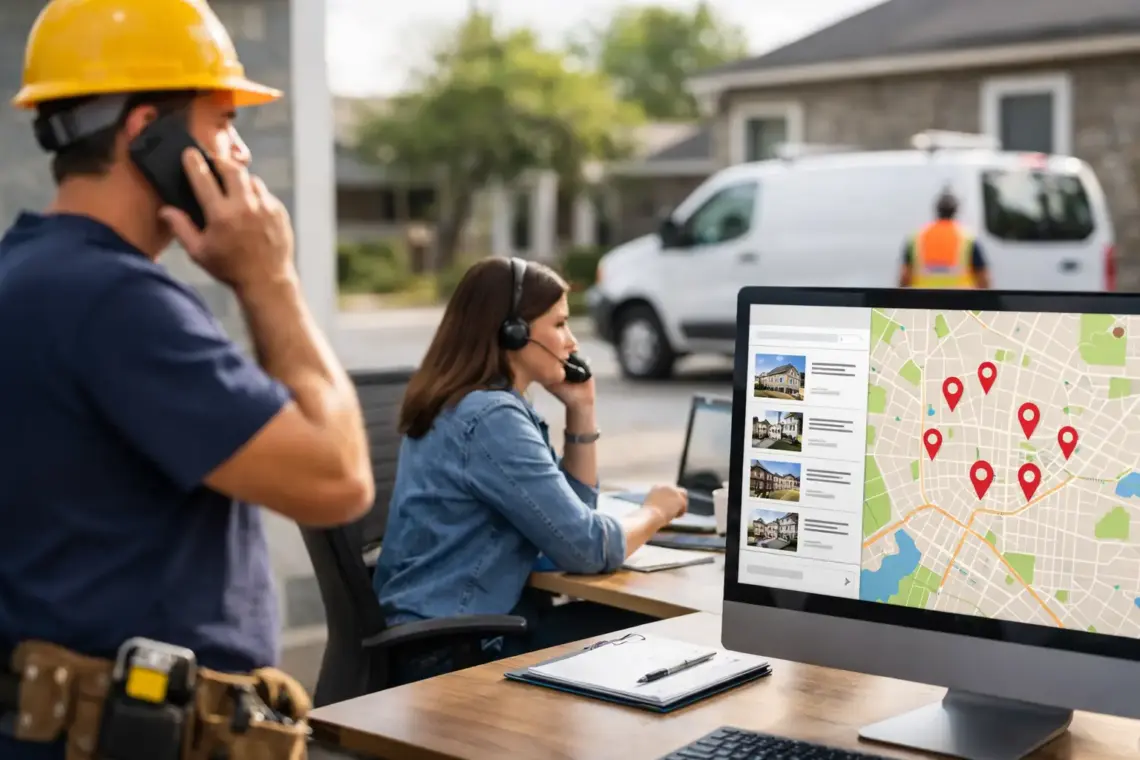
Contractor Map Rankings That Drive Local Calls
A homeowner with a leaking pipe or broken AC unit is not browsing Google for fun. They need help now. Contractor map rankings determine whether they call your business, call another contractor, or never see you at all.
For local service businesses, the Google Map Pack is often the highest-value real estate on the search page. Showing up for searches like “plumber near me,” “roof repair Tampa,” or “AC repair in Orlando” can produce phone calls from people who are ready to book. But ranking on Google Maps is not about filling out a profile once and hoping for the best. It takes accurate business information, local trust signals, reviews, and a website that supports the services you want to sell.
What Contractor Map Rankings Actually Measure
When Google decides which contractors appear in the map results, it looks at three main factors: relevance, distance, and prominence.
Relevance means Google understands what you do. If you are an HVAC company, your profile, website, services, photos, and customer reviews should make it clear whether you handle AC repair, heating repair, ductwork, maintenance, or installation. A vague profile makes it harder for Google to match you to the right search.
Distance is based on where the person searching is located. You cannot force your business to rank everywhere from one office. A Tampa contractor will usually have a stronger chance near Tampa than 50 miles away. That said, strong local signals can help you compete across a reasonable service area, especially when nearby competitors have weak profiles or few reviews.
Prominence is Google’s version of trust. It includes review volume and quality, links and mentions from local websites, how established your business looks online, and whether customers engage with your listing. A complete, active profile sends a stronger signal than one with an old phone number, three photos, and no recent reviews.
Start With a Google Business Profile Built to Convert
Your Google Business Profile is not just a directory listing. It is often the first page a prospect sees. They should be able to tell what you do, where you work, and how to contact you within a few seconds.
Use your real business name exactly as it appears on your truck, licensing documents, and website. Do not stuff extra keywords into the name. Adding phrases like “Best Emergency Plumber Tampa” to a business name may create a short-term bump, but it violates Google’s rules and can lead to edits, suspensions, or lost visibility.
Choose the most accurate primary category. This matters more than most contractors realize. A roofing company should not use a broad category just because it seems to cover more services. Pick the category that best represents the core service you want more calls for, then use relevant secondary categories where they truly apply.
Complete every practical field in the profile: phone number, website, business hours, service areas, appointment options, services, business description, and attributes. Keep the information consistent with your website. If your profile says you serve Clearwater and your website only mentions Tampa, you are creating uncertainty for both customers and Google.
Photos matter because people want proof that you are a real local company. Add clear photos of your team, branded vehicles, completed work, office or shop, equipment, and before-and-after jobs. Avoid stock images when possible. A homeowner is more likely to call a contractor who looks active, local, and accountable.
Make the Phone Call Easy
Map visibility only matters if it turns into leads. Your business phone number should be correct, answered during posted hours, and connected to someone who can schedule work. If calls go to voicemail for hours, you are paying for visibility with missed opportunities.
Use a call tracking number only if it is set up correctly and does not create conflicting business information online. The goal is simple: know which calls come from Google Maps while keeping your core business details consistent.
Reviews Are a Ranking Signal and a Sales Tool
A contractor with 80 recent, detailed reviews will usually earn more trust than one with 12 old reviews, even if both rank well. Reviews influence clicks, calls, and booking decisions. They also give Google more context about the work you perform.
Ask every satisfied customer for a review after the job is complete, while the experience is still fresh. The best time is often right after payment, after a successful inspection, or when the customer tells you they are happy with the work. Make the request personal and simple.
Do not offer discounts, gift cards, or other incentives in exchange for reviews. Do not ask employees, friends, or family members who were not real customers. Fake reviews can damage trust and put your profile at risk.
A useful review does more than say, “Great service.” It mentions the service, location, and outcome naturally. For example, a customer might mention that you repaired an AC system in South Tampa, arrived on time, and explained the issue clearly. You should never script reviews, but you can ask customers to share what work you completed for them.
Respond to every review. Thank positive reviewers by name when appropriate and mention the service provided. Handle negative reviews calmly. A defensive response can cost more jobs than the original complaint. Show future customers that you take responsibility, communicate clearly, and try to resolve problems.
Build Service Pages That Support Your Map Visibility
Your Google Business Profile cannot carry the full load. Your website needs pages that confirm your services and give searchers a reason to contact you.
Create a focused page for each core service you want to rank and sell. An HVAC company may need separate pages for AC repair, AC installation, heating repair, maintenance plans, and indoor air quality. A plumber may need pages for drain cleaning, water heater repair, leak detection, sewer line work, and emergency service.
Each page should explain the problem, who the service is for, what happens next, and how to call or request an appointment. Include real job photos, service-area details where relevant, reviews, and clear contact options. Do not build dozens of nearly identical city pages with the city name swapped out. Thin location pages rarely help for long and can make the site look low quality.
For contractor map rankings, local proof works better than keyword repetition. Mention areas you actually serve. Publish real project examples when you have them. Keep your company name, address, and phone number consistent across the website. If you have a physical location customers can visit, display it clearly.
Fix the Problems That Hold Contractors Back
Many contractors do not need a complete marketing rebuild. They need to fix a few issues that are quietly blocking calls.
First, check for duplicate Google Business Profiles. Old listings from a previous address, a past business name, or an employee-created account can confuse Google and split reviews. Claim or resolve duplicates instead of leaving them active.
Second, make sure your service areas reflect reality. Listing every city in Florida will not make you rank statewide. It can make your profile less credible. Focus on the cities and neighborhoods you can serve quickly and profitably.
Third, review your business hours. If you offer emergency service, make that clear only if someone can actually answer. If you are closed on Sundays, do not list 24-hour service just to attract more clicks. Missed calls and disappointed customers hurt more than inflated hours help.
Finally, look at your website on a phone. Most map searches happen on mobile devices. Your click-to-call button should be obvious. Forms should be short. Pages should load quickly. If a prospect has to pinch, zoom, hunt for your number, or wait for a slow page, they will move to the next listing.
How to Track Whether Rankings Are Producing Jobs
Do not judge success only by whether you appear first when searching from your office. Your location, search history, and device can influence what you see. Rankings also vary across a city.
Track the outcomes that matter: calls from your profile, website form submissions, direction requests, booked appointments, and completed jobs. Review these numbers monthly alongside your highest-value services. If AC repair calls are growing but installation leads are not, your profile and service pages may need stronger installation signals.
Also pay attention to lead quality. More calls are not automatically better if they are for services you do not offer, outside your service area, or from people only looking for the lowest price. The right contractor map strategy attracts searches tied to the work you want more of.
Consistency Beats One-Time Optimization
Google Maps is not a set-it-and-forget-it channel. Profiles go stale. Reviews slow down. Competitors add photos, earn new feedback, and improve their websites. The contractors who hold visibility keep their information accurate and keep adding real proof that they are active in the market.
Set a simple monthly routine: check profile accuracy, upload recent job photos, respond to reviews, request new feedback, and review lead activity. Then fix the weakest point in the path from search to booked job.
The goal is not to look busy online. The goal is for the next local customer with an urgent problem to see your business, trust it, and call before they find someone else.


You May Also Like
Why Are Map Rankings Dropping for Your Business?

Chiropractor Review Request System That Gets Results