A Startup’s Guide to Digital Marketing That Actually Gets Leads
Tired of burning cash on marketing that doesn’t make the phone ring? If you’re running a local service business—whether you’re an HVAC pro in Tampa or a roofer in St. Pete—you know every dollar has a job. This isn’t another fluffy guide filled with vague theories. This is a battle-tested playbook showing you exactly where to put your time and money to get qualified, inbound leads, fast. Stop guessing and start growing.
Your No-Fluff Digital Marketing Strategy for Local Service Startups
Let’s cut right to it. A winning digital marketing strategy for startups, especially for local service companies, isn’t about being everywhere at once. It’s about a sharp, focused approach that prioritizes one thing: generating qualified inbound leads. Forget vanity metrics like likes and shares that don’t pay the bills.
We’re going to walk through how to build a simple website that captures leads, dominate local search so new customers find you first, and use social media to build the kind of trust that turns prospects into clients. By the end, you’ll have a practical framework to stop guessing and start growing.

Why a Smart Strategy Matters More Than a Big Budget
Too many service business owners think they need a massive budget to compete. That’s a myth. A sharp strategy will always beat a fat wallet.
Sure, the digital ad market is noisy. But that noise creates huge opportunities for those who are smart about where they play. When you have a solid plan, even a small, targeted investment can deliver incredible returns.
To put this in perspective, let’s look at the return on investment (ROI) for the channels that matter for local businesses.
Startup Marketing Channel ROI Snapshot
| Marketing Channel | Average Return on Investment (Per $1 Spent) | Best For |
|---|---|---|
| Email Marketing | $36 | Nurturing leads and getting repeat business from past clients. |
| SEO | $22.24 | Long-term, organic growth and attracting high-intent customers. |
| Content Marketing | $9.85 | Building authority, educating customers, and supporting SEO. |
| Paid Search (PPC) | $2 | Getting immediate traffic and leads for specific keywords. |
A well-executed email campaign can generate a mind-blowing $36 for every $1 spent. This proves that precision is power. You can learn more about this in our guide on creating a content generation strategy that works.
The goal isn’t to outspend your competitors; it’s to out-think them. A roofer in St. Petersburg doesn’t need to advertise across all of Florida. They need to be the #1 result when someone in their service area searches “emergency roof repair near me.”
That’s the core of an effective digital marketing plan for any service business. It’s about being hyper-visible to the right people at the exact moment they need you.
Your strategy should be built on three powerful pillars:
- Dominating Local Search: Getting into the Google “Map Pack” so a local customer finds you instantly.
- A High-Converting Website: A 24/7 lead-generation machine that works while you’re on the job.
- Building Trust on Social Media: Showcasing your work, gathering 5-star reviews, and becoming the go-to expert in your town.
Step 1: Build Your Foundation for Lead Generation
Before you spend a dollar on ads, get the groundwork right. Countless startups waste their entire budget because they skip two crucial steps: figuring out who they’re talking to and what they want to accomplish.
A winning strategy isn’t built on guesswork. It’s built on precision.
Your marketing flops when you target “homeowners in Tampa.” It takes off when you target “a 45-year-old father in South Tampa whose A/C just died in the middle of July.” See the difference?
It’s the difference between shouting into an empty stadium and having a direct conversation with someone who desperately needs your help right now.
Define Your Ideal Customer Profile (ICP)
Your ICP is a crystal-clear snapshot of your perfect client. Forget generic demographics. We need to get into the nitty-gritty of their immediate problem.
Actionable Steps: Find Your ICP
- Identify their “hair-on-fire” problem: A burst pipe is flooding their kitchen. A storm just tore shingles off their roof. A sudden toothache is ruining their weekend.
- Pinpoint their frantic Google search: It’s not “plumbing services.” It’s “emergency plumber near me” or “24-hour plumber Tampa.”
- Understand their biggest fear: They’re worried about getting ripped off, hiring a shoddy contractor, or paying for a fix that doesn’t last.
Let’s look at real-world examples for home service businesses.
| Business Type | Generic Target | Strategic ICP |
|---|---|---|
| Roofer | Homeowners needing roof work. | A couple in a 25-year-old home in a St. Pete suburb who just found a ceiling stain after a big storm and are terrified of interior water damage. |
| Real Estate Agent | People looking to buy a house. | First-time homebuyers in their late 20s, pre-approved for a mortgage up to $400k, hunting for a 3-bedroom home in a family-friendly Tampa neighborhood. |
| HVAC Contractor | Anyone with heating/cooling issues. | A small business owner in a Clearwater office whose commercial AC unit failed, leading to unhappy employees and a drop in productivity. |
When you get this specific, your marketing suddenly feels personal and urgent. For a deeper look, check out our guide on effective lead generation for small business.
Set Goals That Actually Matter
Once you know who you’re talking to, you have to define what a “win” looks like. “More business” isn’t a goal; it’s a wish. You need specific, measurable Key Performance Indicators (KPIs) that tie directly to revenue.
Actionable Steps: Set Your KPIs
- Vague: “Get more roofing leads.”
- Actionable: “Generate 15 qualified roofing leads per month through our website and Google Business Profile within 90 days.”
- Vague: “Improve our online presence.”
- Actionable: “Achieve a top-3 ranking in the Google Map Pack for ’emergency plumber St. Petersburg’ within 6 months.”
Nail this, and every dollar you spend will work ten times harder.
Step 2: Dominate Local Search Results
For any local service business, showing up on Google is everything. It’s the difference between a phone that rings off the hook and a painfully empty schedule.
When a homeowner’s AC dies in a Tampa summer, they aren’t using the Yellow Pages. They’re grabbing their phone and searching “emergency AC repair near me.” If you’re not in the top three results, you don’t exist.
Let’s get straight to the tactics that land your business in Google’s coveted “Map Pack.”
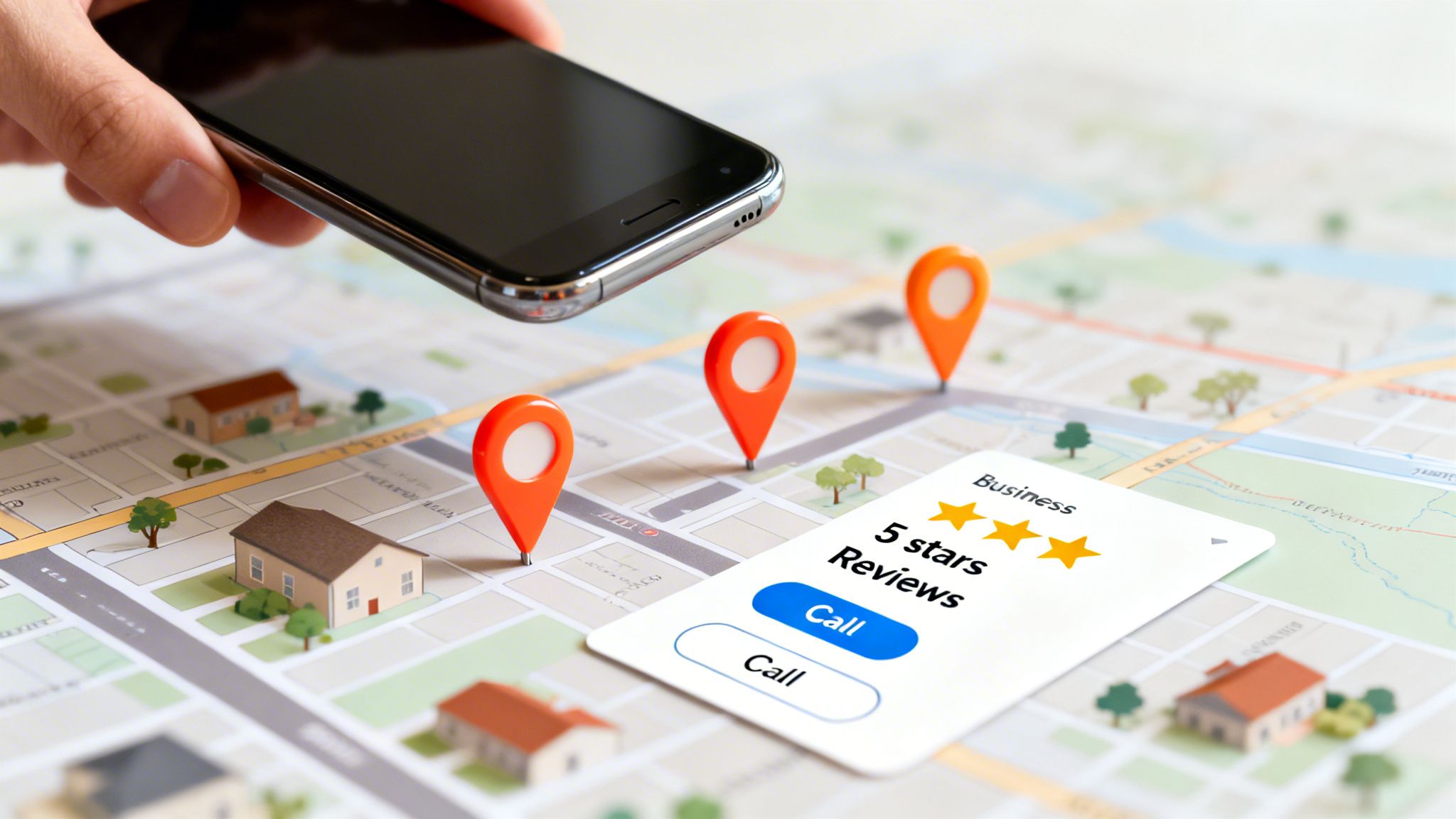
Your Google Business Profile Is Your #1 Asset
Your Google Business Profile (GBP) is the single most powerful tool in your local marketing arsenal. This free profile is what gets you on Google Maps. Optimizing it is the absolute foundation of your digital marketing strategy for startups.
Actionable Steps: Optimize Your GBP
- Claim and Verify It: Go to Google Business Profile and claim your listing. Google will mail a postcard to your physical address to confirm you’re a legit local business.
- Fill Out Every Single Field: Don’t leave anything blank. Add your business hours, define your service areas, and double-check your phone number and website. A complete profile gets 7x more clicks.
- Nail Your Categories: This is critical. Your primary category should be your main service (e.g., “Plumber,” “Roofer”). Then, add secondary categories for every other service you provide, like “Water Heater Installation” or “Drain Cleaning.” This is a key part of our Google Business Profile service.
Build Credibility With Reviews and Photos
A potential customer sees your business next to two competitors. What convinces them to call you? Social proof.
A business with 20 recent, glowing reviews will almost always get the call over a competitor with only two. Reviews are your digital word-of-mouth.
Actionable Steps: Get More Reviews & Photos
- Just Ask: After you finish a job, send the customer a quick text or email with your direct Google review link.
- Respond to Every Review: Thank customers for positive feedback and address negative comments professionally. It shows you care.
- Showcase Your Work: Regularly upload high-quality photos. If you’re a contractor in St. Petersburg, show before-and-after shots of a kitchen remodel, photos of your team on-site, and pictures of your branded trucks.
Use Local SEO To Win Your Service Area
Your GBP gets you on the map, but on-page Local SEO for your website solidifies your authority. This means creating content that tells Google who you are, what you do, and where you do it. To effectively dominate local search, startups need robust local SEO strategies.
A common mistake is having one generic “Services” page. Don’t do that. Create dedicated pages for each core service in each location you serve.
Real-world Example: An electrician in Tampa should build separate pages for:
- “Emergency Electrical Repair in South Tampa”
- “EV Charger Installation in Clearwater”
- “Commercial Lighting Upgrades in St. Pete”
These hyper-specific pages signal to Google that you are the go-to expert for that exact service in that specific area. We’ve seen this work time and again, which is why we created a complete local SEO guide to walk you through it.
The data is clear: SEO delivers an average of $22 for every dollar spent. Check out more powerful digital marketing statistics that prove it.
Step 3: Turn Your Social Media Into a Lead Machine
Let’s be honest. Most local service businesses use social media to post random photos of their truck. That doesn’t get leads. A smart digital marketing strategy for startups reframes social media as a direct-response machine for generating qualified leads.
For most plumbers, roofers, and contractors, forget the noise. Facebook and Instagram are the only platforms that move the needle.
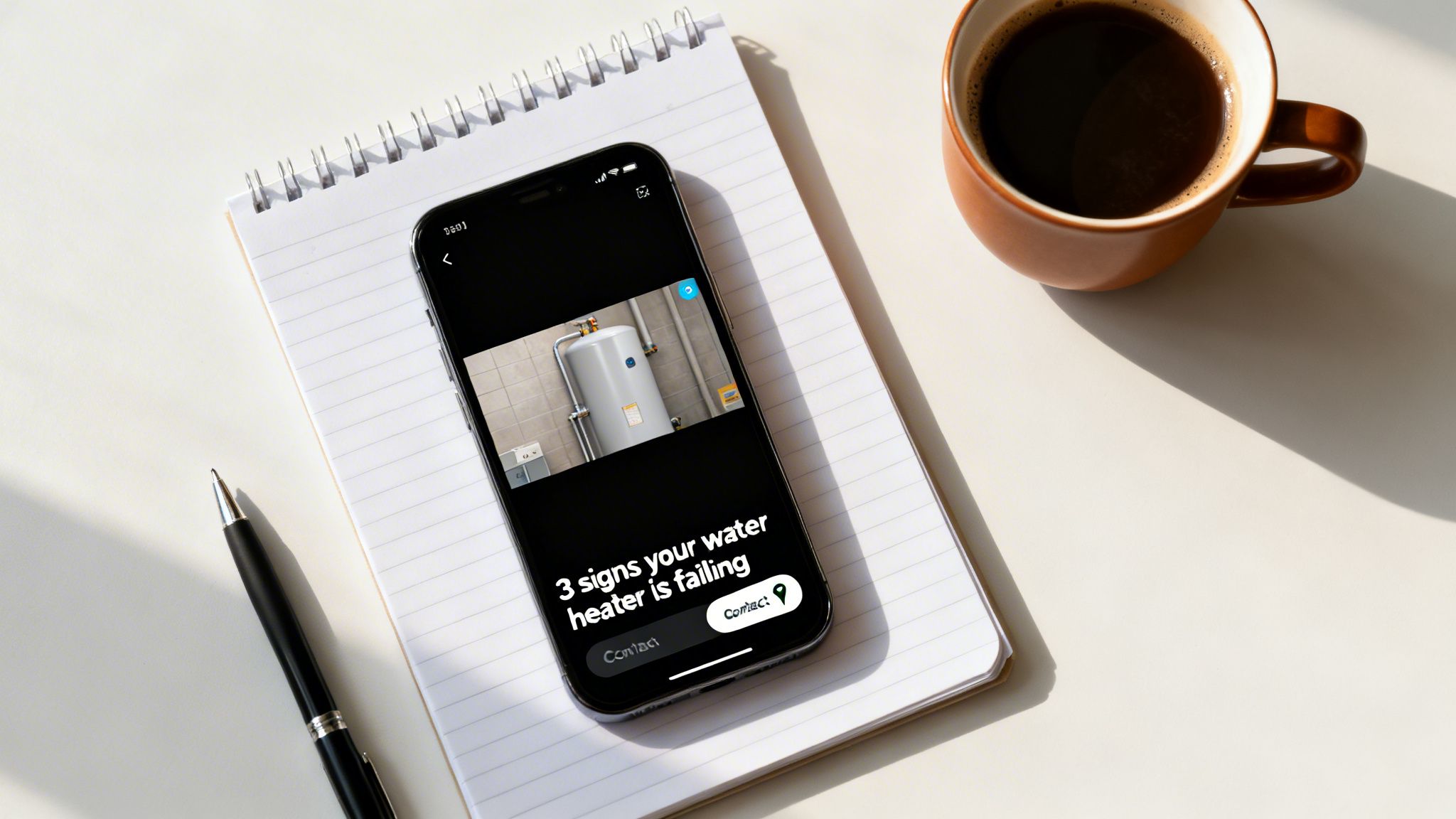
Create Content That Actually Builds Trust
Your social media content needs to do one of two things: solve a problem or calm a fear. Stop posting generic holiday greetings and start giving people real value that cements you as the local expert.
An HVAC contractor in Tampa could post a picture of an AC unit, or they could post a 60-second video titled: “3 Sounds Your AC Makes Before It Dies in the Florida Heat.” Which one do you think a homeowner will remember?
Actionable Steps: Create Content That Works
- A roofer in St. Petersburg: Post a photo carousel: “Before & After: A Recent Tile Roof Repair in Shore Acres.” This is powerful visual proof.
- A plumber: Film a quick tip: “How to Spot a Hidden Water Leak Before It Causes Thousands in Damage.”
- A real estate agent: Do a 10-minute Instagram Live Q&A on “Navigating the First-Time Homebuyer Market in Pinellas County.”
The goal isn’t to go viral. The goal is to become the undeniable local authority. When a homeowner’s pipe bursts, you want your name to be the first one they think of.
This approach builds trust. When you eventually run paid ads, you’re not shouting at strangers. You’re reaching out to neighbors who already see you as a credible expert. Our social media strategy for small business guide can help you build this out further.
Run Hyper-Targeted Ads for Immediate Leads
Organic content builds long-term authority, but targeted ads get your phone ringing now. The Facebook ad platform is incredibly effective for local businesses because you can get ridiculously specific, often for just $10-$20 per day.
Use Facebook Lead Ads. A user taps your ad, and a form pops up pre-filled with their contact info. They just hit “Submit.”
Actionable Steps: Your First Facebook Lead Ad Campaign
Let’s walk through a campaign for a real estate agent in St. Petersburg targeting first-time homebuyers.
- Objective: In Facebook Ads Manager, choose the “Leads” objective.
- Targeting: This is where the magic happens.
- Location: “St. Petersburg, Florida” + a 15-mile radius.
- Age: 25-35.
- Detailed Targeting: Select interests like “Zillow,” “First-time home buyer grant,” and behaviors like “Likely to move.”
- Ad Creative: Use a great photo of an attractive local home. The copy must speak to their pain point.
- Headline: Stop Renting in St. Pete!
- Body Text: Tired of watching your rent go up? Find out how you can own a home for less than you’re paying now. Get our FREE 2024 guide to first-time homebuyer programs in Pinellas County.
- Lead Form: Keep it simple: Name, Email, and Phone Number.
- Budget: Start with $15/day. Let it run for a week and watch the qualified leads roll in.
This model works for any service business. A plumber could offer a guide on “5 Ways to Lower Your Water Bill.” This is how you turn social media from a time-suck into a predictable source of local business. This is a core part of our social media strategy services.
FAQ: Top Startup Marketing Questions
How much should a local service business budget for marketing?
Forget complex formulas. A healthy, effective starting budget for a new local service business is typically $500 to $1,500 per month. The key is to make every dollar count by focusing on lead generation channels like local SEO and hyper-targeted ads, not just brand awareness.
What’s the #1 most important marketing activity for a new contractor?
Your Google Business Profile. Hands down. Before you spend a dime on anything else, completely fill out and optimize your GBP. This free listing is what gets you on Google Maps and is the fastest path to attracting high-intent local customers who need your services now.
Should I focus on SEO or paid ads first?
Both. It’s not an either/or question. Use paid ads (like Google Local Services Ads or Facebook Lead Ads) for immediate lead flow and cash flow. Simultaneously, invest in Local SEO as a long-term asset that will generate “free” leads for years to come. Ads are your sprint; SEO is your marathon.
How long until I start seeing real results from my marketing?
With paid ads, you can start getting leads within the first week. For Local SEO, expect to see significant, measurable improvement in rankings and traffic within 3-6 months of consistent effort. The combination of short-term wins and long-term asset building is the key to sustainable growth.
Do I really need a blog for my plumbing/roofing/HVAC business?
Yes, but not a traditional one. Instead of writing about company news, create helpful articles that answer your customers’ most urgent questions. For example: “How Much Does a New Roof Cost in Tampa?” or “5 Signs Your Water Heater is About to Fail.” This content builds trust and fuels your local SEO, attracting customers who are actively searching for solutions. Check out our startup marketing guide for more ideas.
Tired of guessing? Let’s build a marketing plan that brings qualified leads to your service business—with real, measurable results to prove it.
Book a free, no-obligation strategy call at sparkhive.agency and we’ll give you a clear action plan for your startup.


You May Also Like

Chiropractor Review Request System That Gets Results

Tampa Bay Contractor Marketing That Gets Calls