How to Increase Customer Lifetime Value for Your Service Business
Tired of the constant, expensive scramble for new leads? For a roofer in Tampa or a plumber in St. Pete, chasing one-off jobs feels like you're on a hamster wheel that never stops. The real secret to growing your service business isn't just finding more customers—it's getting more profit from the ones you already have. Stop pouring money into ads to win over strangers and start building a business with predictable, long-term revenue.
This is where you shift your focus to increase customer lifetime value (CLV).
Stop Chasing One-Time Jobs. Maximize Your Profit.
The relentless hunt for new leads is the biggest bottleneck for most local service businesses. It's a strategy that keeps you busy but rarely builds real, predictable wealth.
The smarter move is focusing on your existing customer base. These are people who already know you, trust your work, and have your number saved. Instead of treating each job as the finish line, you need to see it as the starting point of a long-term relationship.

The numbers don't lie. Boosting customer retention by a mere 5% can explode your profits by 25% to 95%.
It costs 5 to 7 times more to acquire a new customer than to keep an existing one. You get a much higher return on every dollar and minute you invest.
Imagine a Tampa HVAC company turning a one-off AC repair into an annual maintenance plan. That customer's value instantly triples. Or a Clearwater real estate agent who helps a family buy their first home, then gets referrals to their friends and family—multiplying the value of that initial commission.
This guide cuts through the fluff and gives you an actionable roadmap. We’ll show you exactly how to:
- Systemize follow-ups to lock in repeat business and generate 5-star reviews.
- Create simple service agreements that build predictable, monthly income.
- Ethically upsell and cross-sell to increase your average job value.
- Automate your marketing so you stay top-of-mind without lifting a finger.
This isn’t broad marketing theory. It’s a practical guide for service business owners who want to stop chasing leads and start building a more profitable company. While CLV is a big topic in online retail, its application for local services is what really matters here. For a different perspective, you can review this guide to Ecommerce Customer Lifetime Value.
It all starts by making it incredibly easy for happy clients to book you again, a topic we dive into in our article on the power of AI appointment schedulers.
Calculate the One Metric That Reveals Your True Profit
If you can't measure it, you can't improve it. Most service businesses track total revenue and job count, but they miss the single most important number for sustainable growth: Customer Lifetime Value (CLV).
Don't let the name intimidate you. This isn't a complex accounting metric. It's a simple calculation that shows you where your real profit is hiding.
Knowing your CLV is the difference between blindly chasing any lead and deliberately attracting customers who will be worth 10x more to your business over time. It lets you make smart decisions about your marketing budget, service offerings, and who deserves your best attention.
A Simple Formula for Service Businesses
Let’s get practical. You can forget the complicated spreadsheets you find online. For a local service business, a working CLV calculation is straightforward.
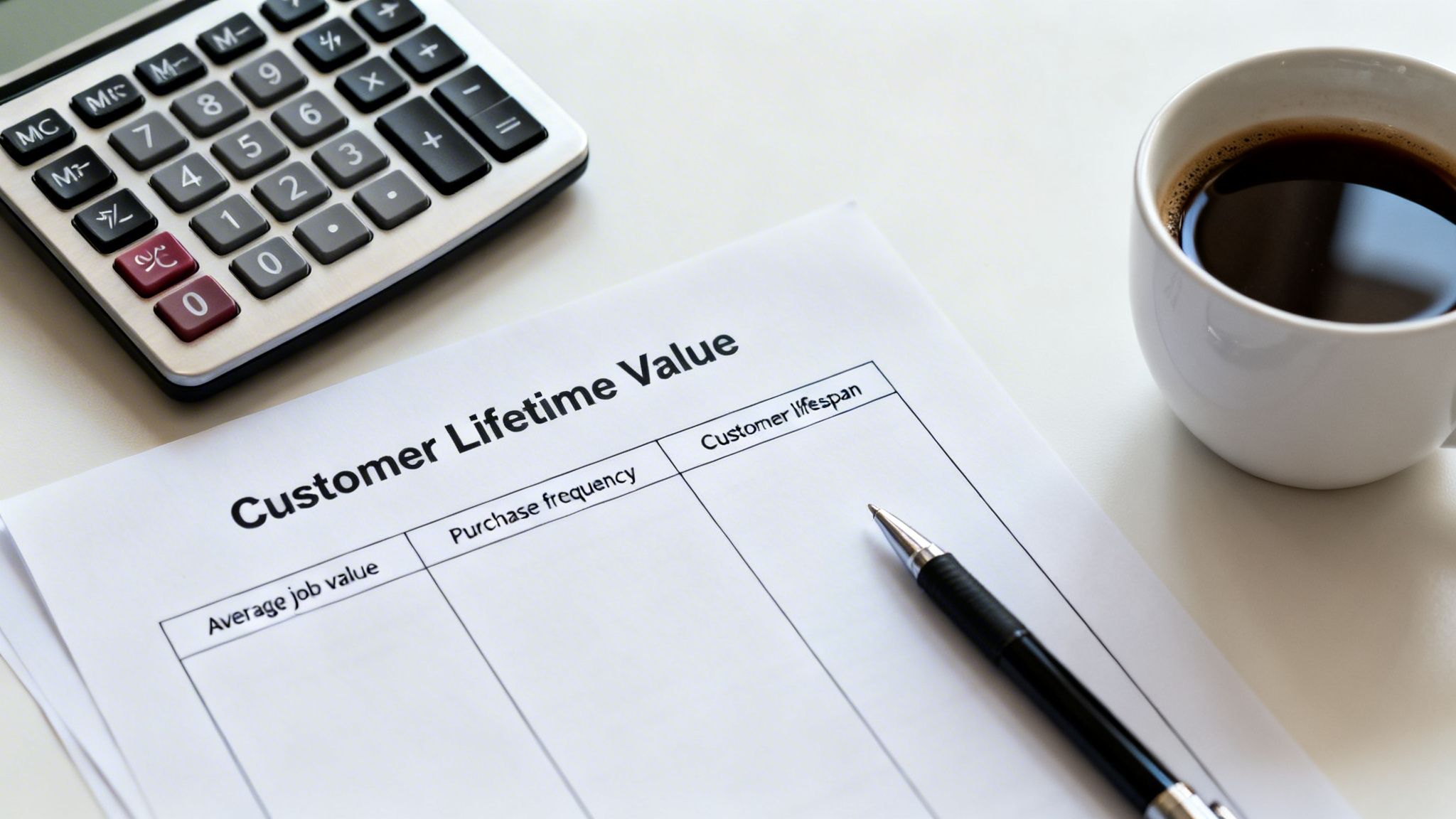
Multiply three key numbers:
(Average Job Value) x (Average Number of Jobs Per Year) x (Average Customer Lifespan)
Here’s a breakdown using a real-world example for a plumbing business in Tampa. Swap in your own numbers.
Step-by-Step: Calculate Your CLV
| Metric | Definition | Example (Tampa Plumber) |
|---|---|---|
| Average Job Value | The average revenue you earn from a single customer transaction. | $450 |
| Average Purchase Frequency | How many times a year, on average, a customer hires you. | 0.8 (some are one-offs, others have annual maintenance) |
| Average Customer Lifespan | The average number of years a person remains your customer. | 7 Years |
| Customer Lifetime Value (CLV) | The total projected revenue one customer will generate. | $450 x 0.8 x 7 = $2,520 |
This quick calculation shows that a single plumbing customer isn't just worth $450 from their first job—they're potentially worth over $2,500.
Why This Number Changes Everything
Once you know your CLV, your entire mindset shifts. You realize a customer on a $20/month maintenance plan is infinitely more valuable than a one-off emergency caller you'll never hear from again.
A Clearwater dental practice might find that a patient who comes for bi-annual cleanings is worth thousands more over a decade than a one-time emergency root canal patient.
This isn’t just an accounting exercise; it’s a strategic tool. It helps you pinpoint exactly who your most profitable customers are so you can find more people just like them.
It also justifies spending more to acquire an ideal client, a key concept we explore in our guide on lead generation for small business. The goal is to build a business full of high-value customers, not just one-and-done jobs.
The Playbook to Keep Customers Coming Back
You finished the job and sent the invoice. So, you’re done, right? Not if you want a profitable business. Without a plan for what comes next, that happy customer will forget your name by the time their next problem rolls around.
This is where the real money is made. You must shift from a one-time problem-solver to their go-to expert for anything related to their home. This doesn't happen by accident; it requires a deliberate playbook. A solid grasp of Retention Marketing is your foundation for turning single paychecks into predictable revenue.
Action 1: Put Service Reminders on Autopilot
For any service with a regular maintenance cycle, a reminder system is a must. It’s the easiest way to generate repeat business. You’re not being pushy; you're providing a helpful service that protects their investment.
- HVAC Example: An automated email and text fires off 11 months after a new AC install in Sarasota. The message: "Time for your annual tune-up to keep your system running strong through the Florida summer and prevent a costly breakdown."
- Roofer Example: After a roof replacement, set a reminder for a one-year inspection. Frame it as a complimentary check-up to look for storm damage and ensure their warranty stays intact.
- Plumber Example: Installed a new water heater? Send a reminder in 12 months to schedule a tank flush. This simple maintenance call can double the life of their unit.
This system works because you get in front of them with a relevant offer before they think about searching Google again.
Action 2: Master Your Post-Job Follow-Up
The few days after you complete a job are critical. Their satisfaction is at an all-time high. This is your chance to lock in a great review and plant the seed for future work.
Here’s a proven flow:
- Same Day: "Job Complete & Feedback" Email. Thank them and ask, "Are you 100% satisfied with the work we did today?" This lets you fix minor issues before they become a bad review.
- 3-5 Days Later: "Review Request" Email. Once you know they're happy, politely ask them to share their experience on Google. Give them a direct link. To master this, learn how to get more Google reviews.
- 30 Days Later: "Value-Add" Email. Send a helpful tip that doesn't ask for anything. For an HVAC client: "3 Ways to Improve Your Home's Air Quality This Fall." This cements your status as the expert.
Action 3: Launch a High-Value Membership Program
If you want the ultimate strategy to increase customer lifetime value, launch a service agreement or membership program. This generates predictable, recurring revenue and makes your best customers immune to competitors.
Bundle services they already need with perks that make joining an easy decision.
- Plumber: A "Home Protection Plan" for a monthly fee. Includes an annual inspection, priority scheduling, and a 15% discount on future repairs.
- Electrician: A "Safe & Secure" membership. Includes an annual safety inspection, free smoke detector battery replacement, and a discount on installing a generator.
- Real Estate Agent: A top agent in St. Pete tracks her clients' "home-iversaries." Every year, she sends a small, thoughtful gift and a handwritten note. This simple gesture keeps her top-of-mind and turns one commission into a referral engine.
Programs like these change the dynamic. You’re no longer just a contractor; you’re a trusted partner.
Ethically Upsell to Boost Every Job's Value
"Upselling" makes most service pros cringe. It brings to mind a pushy salesperson. But when done right, it's not aggressive; it's about being a true expert.
You anticipate your customer’s needs and offer a more complete solution. This approach doesn't just increase customer lifetime value—it builds incredible trust and makes them see you as a long-term partner.
Action 1: Train Techs to Think Like Consultants
Your field technicians are your biggest asset here. They're on-site, seeing things the homeowner would never notice. You need to shift their mindset from repairman to consultant.
Start with a "Good, Better, Best" framework. Empower your team to present options.
- Good: The standard repair that solves today's problem.
- Better: The repair plus a preventative step to keep the issue from recurring.
- Best: A full system upgrade or related service that boosts efficiency or safety.
When a Clearwater HVAC tech goes out for an AC repair, they shouldn't just replace a part and hand over the bill. They are in the perfect spot to see the bigger picture.
Action 2: Use On-Site Observations to Start Conversations
Here’s what this looks like in practice. The key is to lead with an observation, not a pitch.
HVAC Technician Scenario:
- Observation: "While I was working on your AC, I noticed your air filter is clogged and there’s a lot of dust in the system. Has anyone in the house struggled with allergies?"
- Cross-Sell: This is the opening to talk about indoor air quality solutions, like a whole-home air purifier or duct cleaning.
- Upsell: It’s also the time to introduce a smart thermostat, framing it as a way to improve comfort while cutting energy bills.
Roofer Scenario:
- Observation: "We're done with the shingle repair, but I saw your gutters are packed with leaves. The next big Tampa rainstorm could cause water to back up right under the work we just did."
- Cross-Sell: Offer a gutter cleaning service on the spot, or suggest gutter guards to prevent it from happening again. It's a small add-on that protects their larger investment.
This approach is powerful because it's rooted in genuine value. You’re solving problems your customers didn't even know they had. This also feeds your marketing—you can create content that addresses these problems, a topic we cover in our guide on building a content generation strategy.
Action 3: Follow Up with No-Pressure Offers
Not every customer says "yes" on the spot. Don't apply pressure. Instead, plant the seed.
Have your tech add a note to the customer’s file. A few days later, an automated email can follow up. Imagine an email with the subject: "A quick follow-up on your home's air quality."
The email can include:
- A reminder of the tech's observation.
- A link to a helpful blog post ("3 Signs Your Home's Air Quality Is Hurting Your Health").
- A soft offer: "If you'd like to learn more, we can put together a no-obligation quote for you."
This feels helpful, not salesy. It keeps the conversation alive and lets the customer decide on their own terms.
Let Smart Automation Drive Your Growth
You can't personally call every client. But technology can. This is how you put your strategy to increase customer lifetime value on cruise control.
The goal is to set up smart systems that consistently nurture your database, making sure no past customer forgets your name. This is the secret to unlocking scalable growth. We dive deep into this in our guide on AI and marketing automation.
Step-by-Step Automation Workflow
Let's make this concrete. Here’s a workflow for a St. Petersburg landscaping company aiming to upsell clients from basic mowing to a full-service fertilization and pest control package.
It starts when a customer signs up for the "Basic Bi-Weekly Mowing" plan. This triggers an automated email sequence.
- Email 1 (Day 15): A value-first message with the subject, "3 Weeds Taking Over St. Pete Lawns Right Now." It’s a helpful, localized article that educates the customer.
- Email 2 (Day 45): Introduce the problem. The subject: "Is Your Lawn Getting the Nutrients It Needs?" This email explains why mowing alone isn't enough for Florida's sandy soil.
- Email 3 (Day 75): Make the offer. The subject: "A Special Offer for a Healthier Lawn." This email presents the benefits of the fertilization package and includes a limited-time discount for existing clients.
This sequence works because it’s not a blunt sales pitch. It educates, builds trust, and makes the upsell feel like a natural solution.
This simple flow chart shows how your team can turn a routine repair call into a much more valuable upgrade.
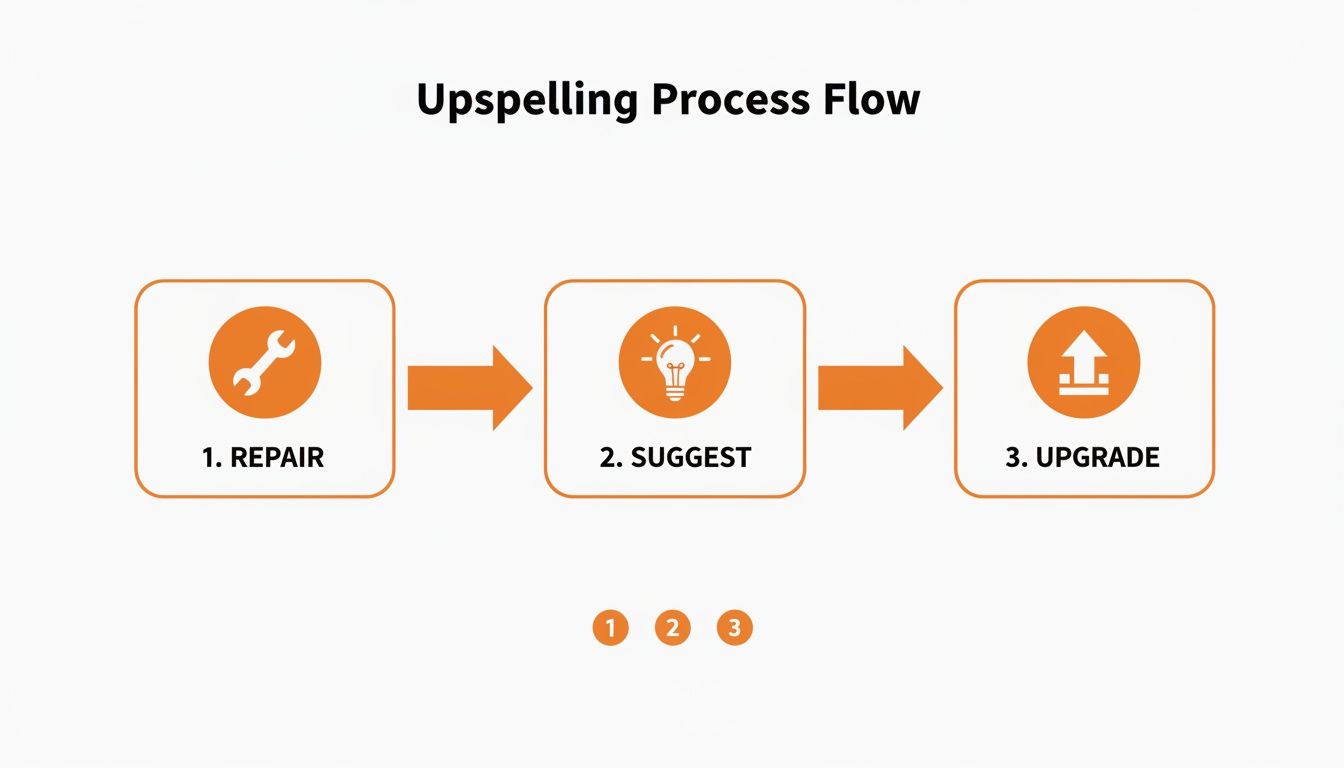
As you can see, every service call is a chance to guide a customer from a quick fix toward a more comprehensive, long-term solution that benefits both of you.
Your website and Google Business Profile are essential here. They are the welcome mat for repeat business, making it easy for past customers to book their next service call without friction.
FAQ: Your Questions on Increasing Customer Lifetime Value Answered
1. What’s the first thing I should do to increase CLV?
Calculate your baseline CLV. Use the simple formula: (Average Job Value) x (Average Jobs Per Year) x (Average Customer Lifespan). This number will immediately show you where your profit is hiding and which strategies to focus on first—high-value one-time jobs or smaller recurring services.
2. My business is mostly one-time jobs. Can I still increase CLV?
Yes. Your focus shifts from repeat purchases to referrals and brand loyalty. A roofer in St. Pete can offer a referral bonus to a past client. A real estate agent's CLV skyrockets when a happy client refers their family and friends. The goal is to build a system that keeps you top-of-mind and gives past customers a reason to be your advocate.
3. How quickly can I see results from this?
You can see movement in 3-6 months by focusing on low-hanging fruit, like implementing a post-job follow-up sequence. The foundational shift in your business—the kind that boosts profits by 25% or more—typically reveals itself over a 12-24 month period as repeat business and automated nurturing take hold.
4. Isn't this too complicated for a small service business?
Not if you start small. The biggest mistake is trying to do everything at once. Pick one strategy and get it right. A perfect starting point is the 'Post-Job Follow-Up.' Create a simple, three-part email series that goes out automatically. You don't need a huge team. Modern tools like HubSpot or Jobber make this straightforward.
5. Should I discount services for repeat customers?
Tread carefully. Instead of slashing prices, frame it as "preferred pricing" or a "loyalty benefit" in a membership. Priority scheduling during your busy season is often a much more powerful incentive than a small discount for a local service business.
Ready to stop the endless chase for one-off jobs and start building a more predictable, profitable business? The key is focusing your efforts to increase customer lifetime value.
At Spark Hive, we build the specific systems and automation that Tampa-area service businesses need to turn their past customers into their most valuable asset. If you're ready to see how this could work for your business, book a no-obligation strategy call with our team.


You May Also Like

Tampa Local SEO Services That Drive Leads

Stop Wasting Money: A Content Generation Strategy That Actually Books Jobs