AI Marketing Trends 2026 for Local Businesses
If your business lives on phone calls, quote requests, and booked appointments, the biggest shift in ai marketing trends 2026 is simple: speed will matter more than volume. More tools will promise more traffic. The businesses that win will be the ones that answer faster, follow up better, and show up stronger in local search.
For a related guide, see our article on Attract High-End Clients: AI Marketing for Interior Design Businesses.
That matters a lot more for a roofer, dentist, plumber, or HVAC company than the latest flashy app. Most small businesses do not need more noise. They need a system that turns existing demand into steady inbound leads.
What AI marketing trends 2026 actually mean for local businesses
A lot of AI talk is built for big brands with big teams. That is not your situation. If you run a local service business, you need marketing that helps people find you, trust you, and contact you without friction.
So when we talk about ai marketing trends 2026, we are not talking about gimmicks. We are talking about practical changes in how people search, how Google reads business information, and how quickly leads expect a response.
The shift is already happening. Search results are getting more crowded. Customers are comparing businesses faster. And if a lead fills out your form at 8:12 p.m., they do not want a reply tomorrow afternoon. They want a text, email, or callback now.
Trend 1: AI-assisted search will make local trust signals more important
Search is changing, but local intent is still local intent. Someone searching for an emergency plumber or a chiropractor near home is still looking for a real business with real reviews, real service pages, and clear contact information.
What changes in 2026 is how search engines pull and summarize information. AI-assisted results will rely heavily on business data that is consistent and easy to understand. That includes your Google Business Profile, your website content, your reviews, your service areas, and your business details across the web.
If your information is outdated, vague, or thin, you make it harder for search engines to trust you. If your site clearly explains what you do, where you work, and how to contact you, you have a better chance of staying visible.
This is not a reason to rewrite your whole website with AI. In fact, that can backfire fast. Thin, generic copy will not help you rank or convert. The better move is tighter service pages, stronger location relevance, and review content that matches the jobs you actually want.
What to do now
Make sure your business name, phone number, hours, and service areas match everywhere. Tighten your Google Business Profile. Add real service-specific content to your site. Build pages for high-intent searches, not broad vanity terms.
Trend 2: Lead response automation will stop being optional
Most local businesses do not lose leads because of bad service. They lose leads because they respond too slowly.
That is why one of the most useful AI marketing trends 2026 is automated lead follow-up. Not fake conversation. Not robotic sales scripts. Just fast, reliable response when a lead calls, texts, or fills out a form.
A good system can send an immediate text after a missed call, confirm form submissions, route leads to the right person, and remind your team to follow up. It can also sort basic inquiries so your staff spends less time chasing low-quality messages.
There is a trade-off here. Too much automation feels cold. Too little automation costs you jobs. The right setup handles speed first, then hands off to a real person as soon as possible.
For a small business, this can be the difference between getting the job and being the business that never called back.
Where automation helps most
It works best in the first 5 to 15 minutes after a lead comes in. That is when people are still comparing options. A quick confirmation message and clear next step can keep them from moving on.
Trend 3: AI will improve review generation and review use
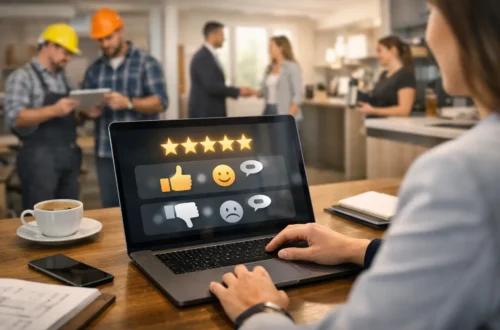
Reviews have always mattered. In 2026, they will matter even more because they help both rankings and conversions.
AI can help local businesses request reviews at the right time, organize feedback, and spot patterns in customer complaints or praise. It can also help you turn review themes into better website copy. If customers keep saying you were fast, clean, and easy to work with, those are not just nice words. They are selling points.
But do not fake this. Automated review requests are smart. Fake reviews are a liability. Search platforms are getting better at spotting patterns that do not look natural, and customers can tell when something feels off.
The best use of AI here is simple. Ask more real customers for reviews. Make the process easy. Then use the language from those reviews in your site, your Google Business Profile, and your follow-up messaging.
Trend 4: Websites will need to do more than look good
Many small business websites still act like online brochures. That will not hold up in 2026.
A strong local website needs to answer questions fast, load quickly, show proof, and give people an easy way to contact you. AI tools can help improve chat, routing, scheduling, and lead capture. But none of that matters if the site is unclear or built around the wrong goal.
For service businesses, the goal is not more page views. The goal is more calls and better leads.
That means your site should make the next step obvious. If someone lands on your water heater repair page, they should see what you do, where you work, why people trust you, and how to reach you right now. No hunting around. No long blocks of filler text.
This is where many businesses get distracted. They add AI widgets before fixing weak headlines, poor mobile layouts, or buried contact forms. The basics still carry most of the weight.
Trend 5: Better data will beat more content
One mistake small businesses will make with AI in 2026 is producing too much content that does not support revenue.
If you serve local customers, you do not need endless blog posts. You need accurate tracking so you know which pages, calls, forms, and campaigns actually produce jobs.
AI can help by organizing lead data, spotting trends, and showing where leads are dropping off. Maybe your Google Business Profile gets views but not calls. Maybe your service page gets traffic but the form is too long. Maybe leads from one city close better than leads from another.
That kind of insight is useful because it leads to action. More content is only useful if it solves a ranking or conversion problem.
What to measure
Track calls, form submissions, booked appointments, missed calls, and response time. If you cannot see those clearly, you cannot improve them clearly.
Trend 6: Search visibility and follow-up will become one system
In the past, some businesses treated SEO, websites, and lead handling as separate projects. That gap will hurt more in 2026.
Getting found is only part of the job. If your rankings improve but your team misses calls, your marketing is still leaking revenue. If your website converts well but your local visibility is weak, you still have a traffic problem.
The smarter approach is to connect these pieces. Show up in local search. Send traffic to focused service pages. Capture the lead cleanly. Follow up fast. Keep the pipeline moving.
This is where AI becomes useful for small businesses. Not as a replacement for good marketing, but as a force multiplier for the boring parts that usually get skipped.
What small business owners should ignore
You can safely ignore most of the flashy AI advice made for national brands or content creators. If a strategy does not help you rank locally, answer leads faster, or book more jobs, it probably does not belong at the top of your list.
Be skeptical of anything that promises full automation. In local services, trust still closes deals. People want to know a real person will show up, do the work, and stand behind it.
It also makes sense to move carefully with customer-facing AI. A missed detail in a chatbot conversation is a minor problem for a blog. It is a big problem if someone needs emergency AC repair or is trying to book a dental appointment.
Where to focus first in 2026
If you want a practical response to ai marketing trends 2026, start with three things: local search visibility, website conversion, and lead follow-up speed. That is where the fastest gains usually show up for service businesses.
Get your Google Business Profile and local pages in shape. Make sure your website is built to convert on mobile. Add simple automation for missed calls, new forms, and appointment follow-up. Then review the data every month and fix the weak spots.
That approach is not flashy. It is effective. And for small businesses that need more consistent calls and bookings, effective is what matters.
The businesses that win next year will not be the ones using the most AI. They will be the ones using it to remove delays, tighten operations, and make it easier for ready-to-buy customers to choose them.
Related resources for Tampa Bay business owners


You May Also Like

Elevate Your Interior Design Brand with AI-Driven Marketing

How to Improve Appointment Booking Fast