How Local Business Citations Get Your Phone to Ring
Tired of seeing your competitors' vans all over town while your phone stays silent? You might have better crews and fairer prices, but they're showing up on Google Maps and you're not. The reason is often a simple but powerful tool called local business citations. If customers can't find your name, address, and phone number online, you're invisible. Getting this right is the first step to turning online searches into booked jobs.
This guide gives you the exact, no-fluff playbook to fix your online listings, build trust with Google, and start generating the inbound leads you need to grow your service business.
What Are Local Business Citations and Why Should You Care?
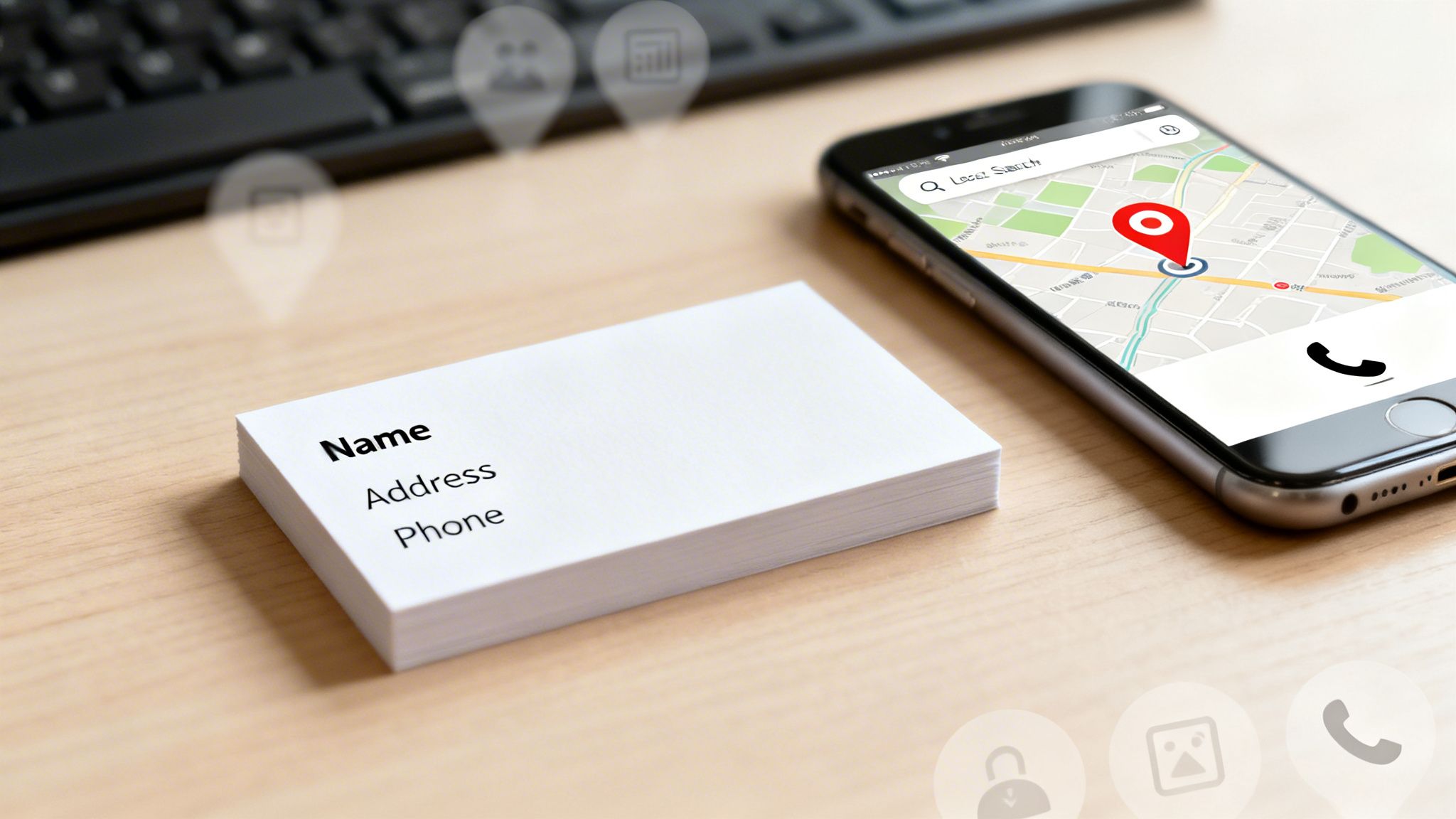
A citation is any online mention of your business’s core information: Name, Address, and Phone number (NAP). These mentions appear on directory sites like Yelp, social media profiles, and industry-specific portals like Angi or Houzz.
Think of each citation as a vote of confidence for your business. When a homeowner in Tampa searches "emergency roofer," Google scans the web to verify local businesses. If it finds your NAP listed consistently across dozens of reputable sites, it trusts that you are a legitimate, active company.
That trust is what gets you ranked in the Google 3-Pack, putting your business in front of customers who are ready to hire someone right now.
The Real Cost of Inconsistent Citations
A messy online presence isn't just a minor issue—it's actively costing you jobs.
| Business Outcome | With Consistent Citations | With Inconsistent Citations |
|---|---|---|
| Google Ranking | Higher visibility in local search and Google Maps. | Buried on page two; practically invisible to customers. |
| Customer Trust | Customers easily find and call you, seeing you as reliable. | Customers find old addresses or wrong numbers, leading to frustration and lost sales. |
| Lead Generation | A steady stream of calls from qualified local customers. | Sporadic leads, or worse—total silence from the web. |
| Brand Reputation | A strong, unified online presence that builds authority. | A fragmented, confusing presence that makes you look unprofessional. |
Inconsistent citations—an old address on one site, a typo in your phone number on another, or using "Dave's Plumbing" vs. "Dave's Plumbing, LLC"—create confusion. This confusion tells Google you can't be trusted, and your rankings suffer.
Citation signals are a top 5 ranking factor for Google's local algorithm. Mastering your local business citations isn't just busywork; it's the foundation for getting found by the customers who need your services.
To see where your business needs to be listed, check out the top business listing sites for USA businesses.
Your Step-by-Step Plan to Find and Fix Citation Errors
Vague advice doesn’t fix a leaky pipe, and it won’t fix your lead flow. If you suspect inconsistent local business citations are sending customers to competitors, it’s time to take control. Here’s the exact plan to audit and clean up your online presence.
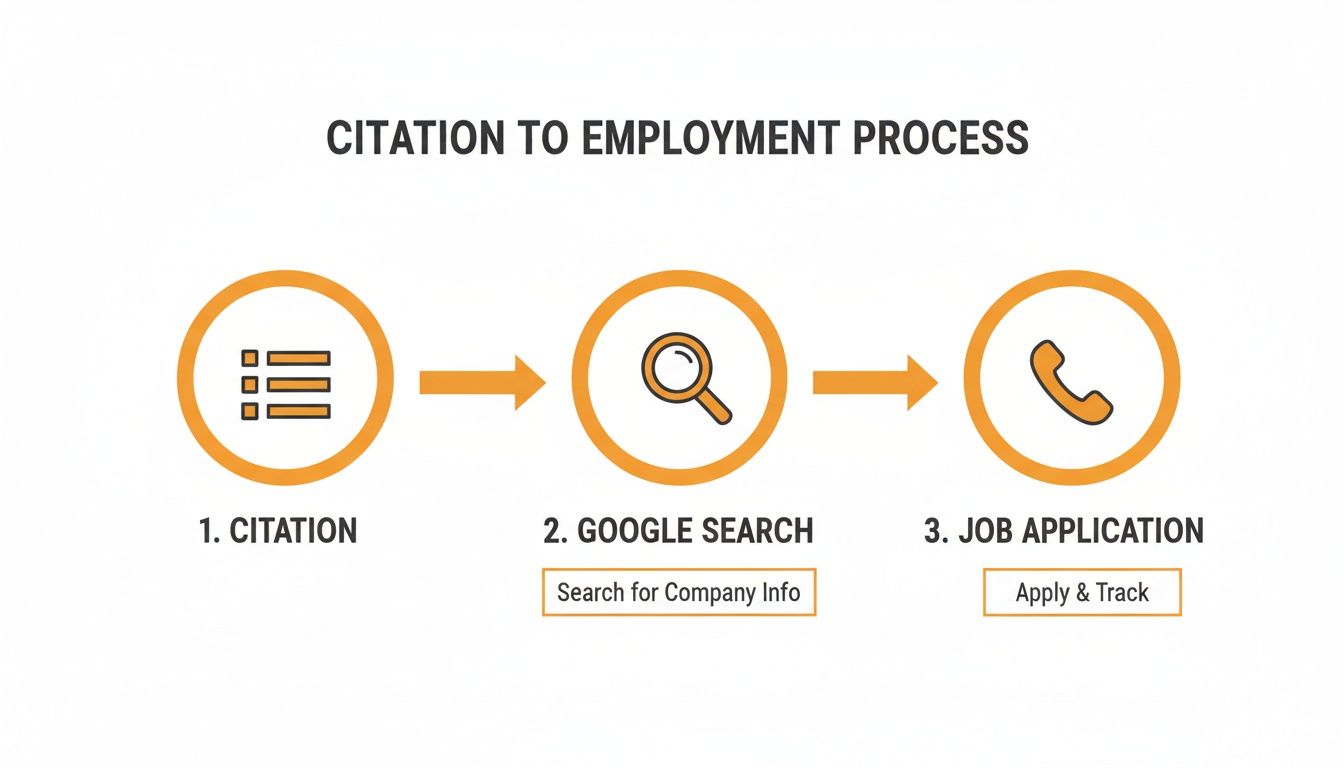
This graphic shows how a clean citation leads directly to a new job. An error at the start breaks the entire chain.
Step 1: Establish Your "NAP Source of Truth"
Before you touch a single listing, you must define your master NAP (Name, Address, Phone Number). This is the gold standard that every online mention must match. No exceptions.
Open a document and write down the following with obsessive detail:
- Official Business Name: Are you "Clearwater Roofing Pros" or "Clearwater Roofing Pros, LLC"? Pick one and stick with it.
- Physical Address: Write it out exactly as Google Maps does. Use "Street" or "St." consistently. If you're a service-area business running from home, use your registration address (you'll hide it on public profiles).
- Primary Phone Number: Use a real, local business number. Do not use call tracking or 800 numbers here.
This document is your bible. Don't move on until it's set in stone.
Step 2: Hunt Down All Existing Citations
Now it’s time to find every place your business information appears online. You can't fix what you don't know is broken.
There are two ways to do this:
- Manual Search (The Hard Way): Go to Google and search for variations of your business name, phone number, and address. For example, a plumber in St. Petersburg might search:
"Pete's Plumbing St. Pete""Pete's Plumbing" + "123 Main St"(727) 555-1234
- Use a Citation Tool (The Smart Way): Services like Whitespark or BrightLocal save you hours by running an automated audit. They scan hundreds of directories and flag all inconsistencies for you.
Step 3: Document and Prioritize the Mess
Create a simple spreadsheet to track your findings. Use these columns:
- Directory/Website Name (e.g., Yelp, Angi)
- URL of Your Listing
- Status (Correct, Incorrect, Duplicate)
- Notes (e.g., "Wrong phone number," "Old address")
Prioritize your fix list. Start with the heavy hitters: Google Business Profile, Apple Maps, Bing Places, and top industry directories (Angi, Houzz, etc.). An error on one of these is far more damaging than on an obscure blog. This is the same principle we use in our website launch checklist—handle the most critical items first.
Step 4: Execute the Cleanup
With your prioritized list, it's time to get to work. For each incorrect listing, you’ll need to claim it if you don't already have access. Most directories have a "Claim this business" link.
Once you’re in, meticulously update the information to match your NAP source of truth from Step 1. If you find duplicate listings you can't edit, contact the directory's support team and request they merge or remove them. This can take time, but it's essential to stop confusing Google and your customers.
How to Build High-Impact Citations That Google Loves
You’ve cleaned up the mess. Now, it's time to strategically build new, high-quality local business citations that will actually get you more leads.
Warning: Do not blast your business info out to hundreds of random directories. That's an old-school tactic that no longer works. Quality beats quantity every time.
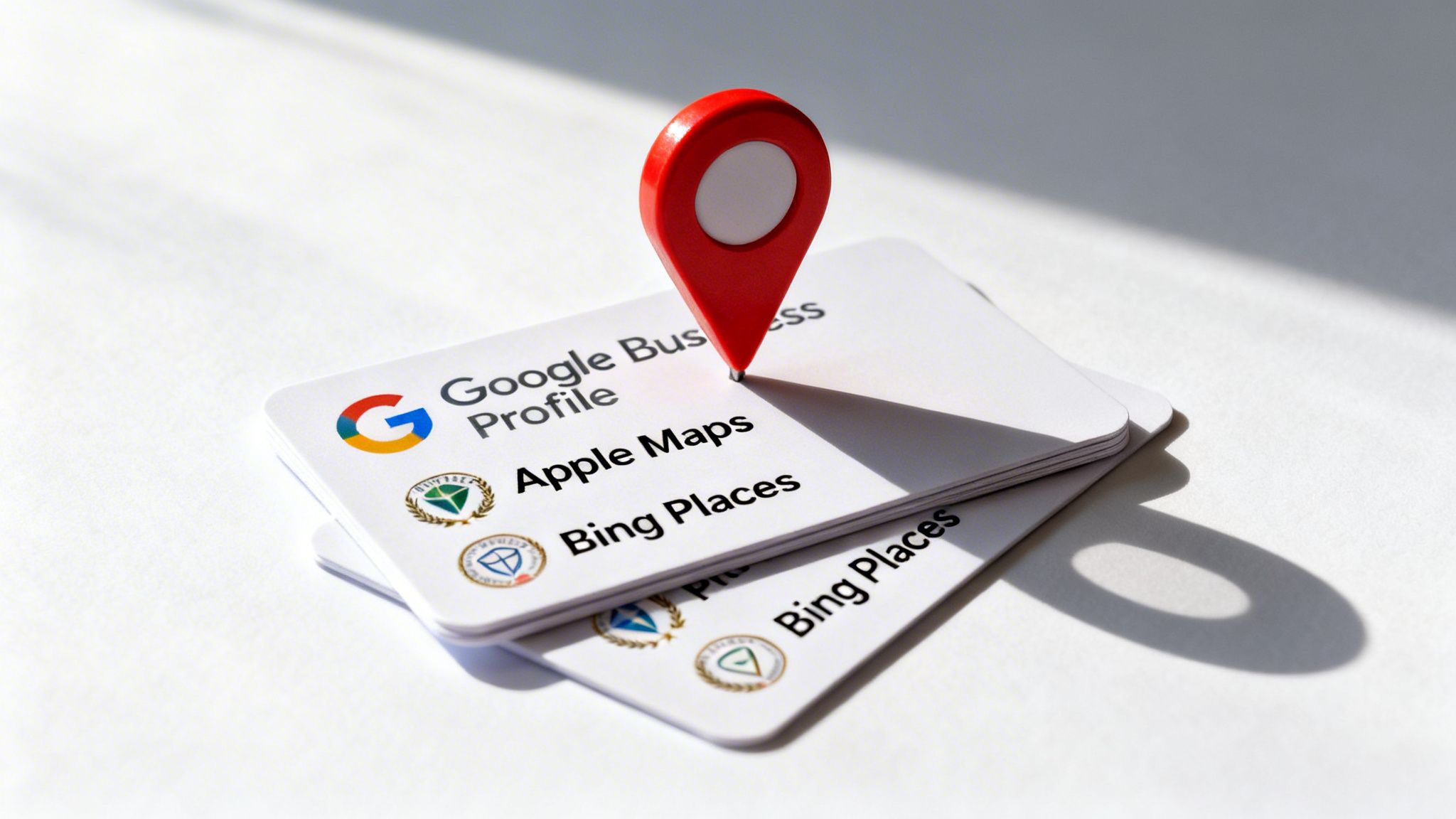
Step 1: Lock Down the Foundational Four
These platforms are the bedrock of your local online presence. Many smaller directories pull data from them, so getting these right is non-negotiable.
- Google Business Profile: This is the single most important profile for any local business. Everything starts here. Learn how to optimize your Google Business Profile to stand out in your area.
- Apple Maps (via Business Connect): Essential for reaching millions of iPhone users who search for services every day.
- Bing Places for Business: Secures your spot on Microsoft's search engine.
- Yelp: A powerhouse for local reviews and a go-to for customers actively looking for service pros.
Perfect NAP consistency across these four is your ticket to climbing the ranks in the Google Map Pack. We cover this in our guide on how to rank your business in Google Maps.
Step 2: Target Industry-Specific and Hyper-Local Sites
Next, build citations on directories that are hyper-relevant to what you do and where you do it. These send powerful trust signals to Google.
- A home contractor in Tampa needs to be on Angi, Houzz, and Thumbtack.
- A real estate agent in St. Petersburg must have a polished profile on Zillow and Realtor.com.
- A dentist in Clearwater must be listed on Healthgrades and Vitals.
Then, go hyper-local. Get listed with your local Chamber of Commerce, neighborhood publications, or community directories. A single, relevant local citation is worth more than 100 generic ones.
Step 3: Find Unstructured Citation Opportunities
These are mentions of your business that don't fit in a neat directory format. Think about:
- Sponsoring a local youth sports team (and getting a link on their site).
- Being featured in a blog post about the "Best HVAC Companies in Tampa Bay."
- Getting a mention in a local newspaper article.
These unstructured citations are digital word-of-mouth that prove your local relevance and are a key part of smart online reputation management best practices.
This tiered strategy builds authority the right way. For a deeper dive, see this excellent Modern Guide to SEO for Cleaning Services.
The Most Common (and Costly) Citation Mistakes
It's the simple errors that do the most damage. You could be the best electrician in Pinellas County, but if Google can't verify your contact info, it will show your competitor instead. Here are the blunders we see service pros make every day.
Inconsistent NAP Information
This is the #1 citation killer. Your Name, Address, and Phone number (NAP) must be identical everywhere.
- Name: "ABC Plumbing" vs. "ABC Plumbing Inc."
- Address: "123 Main St." vs. "123 Main Street"
- Phone: "(813) 555-1234" vs. "813-555-1234"
These small differences look like red flags to Google's algorithm. Pick one format and use it with religious consistency. Your NAP is your business's digital fingerprint; it has to be the same everywhere.
Using Call Tracking Numbers Incorrectly
Call tracking numbers are great for measuring ad campaign ROI, but putting them in your core NAP on Google Business Profile or Apple Maps is a huge mistake. Google uses your primary phone number as a core identifier. Using tracking numbers in these spots confuses it.
The Fix: Use your main business number for all foundational citations. Use tracking numbers on specific landing pages or in secondary "tracking" fields only.
Duplicate Business Listings
Duplicates happen when you move, change your phone number, or an employee accidentally creates a new profile. They split your reviews and authority, confusing both Google and potential customers.
Imagine a homeowner finds two listings for your business—one with 50 great reviews and one with zero. That hesitation is enough for them to call someone else. This is why having good reviews is only half the battle; they must be consolidated. Mastering Google Business Reviews is useless if they are split across multiple profiles.
Using P.O. Boxes or Virtual Offices
Google requires a real, physical address for verification, even for service-area businesses. Using a P.O. Box or a virtual office is a fast way to get your Google Business Profile suspended.
If you work from home, use your home address for registration, then hide it from public view in your Google Business Profile settings. Don't try to cheat the system—it will catch you.
Local Business Citations: FAQ
Let's cut through the noise and answer the most common questions we get from service business owners.
How long does it take to see results from building citations?
This isn't an overnight fix. While Google may index some corrections in a few weeks, you should expect to see a real, measurable impact on your local rankings in 3 to 6 months. You're building a reputation with Google, proving over time that your business is legitimate. This earns the lasting authority that brings a steady flow of leads.
Can I use my home address for my service business?
Yes, but you must do it correctly. If you're a plumber, electrician, or roofer who travels to customers, using your home address for verification is standard. The crucial step is to hide your address from public view in your Google Business Profile settings. You'll verify your business at home, but then set a "service area" on the map. Showing a residential address that customers can't visit is a policy violation and can get your profile suspended.
What's the difference between structured and unstructured citations?
It's simpler than it sounds. It's all about formatting.
- Structured Citations: These are your classic directory listings on sites like Yelp, Angi, or your Google Business Profile. Your NAP is put into specific fields, making it easy for search engines to read.
- Unstructured Citations: These are mentions of your business in a more natural context. For example, a local news site naming you one of the "Best Roofers in Tampa" or a community blog linking to your website. They aren't in neat boxes, but they still prove your local authority to Google.
Do I still need citations if I have a good website?
100% yes. A great website and strong citations do two different but equally critical jobs. Your website is your sales tool for customers. Citations are your verification tool for Google. They prove where you are and that you're a real, local operation. Your website is the digital storefront; citations are the business licenses and utility bills that verify your existence across the web. To win in local search, you absolutely need both.
Stop Managing Listings and Start Booking Jobs
You're an expert at your trade—HVAC, roofing, plumbing. You didn't get into business to spend hours fighting with online directories. That's our job.
Managing your local business citations is a tedious, frustrating chore that pulls you away from running your business. Let our team handle the digital busywork so you can focus on what you do best: serving customers and closing deals.
We Build the Digital Foundation That Gets You Calls
This isn't a one-time fix. It’s a core part of our Local SEO services, designed for service pros who need results, not another to-do list.
Here’s our process:
- Full-Scale Audit: We hunt down every online mention of your business to find the errors and duplicates hurting your rankings.
- Manual Cleanup: Our team manually claims and corrects every listing, ensuring your NAP is 100% consistent everywhere.
- Strategic Citation Building: We build powerful new citations on the industry and local directories that matter for your trade.
- Ongoing Protection: We monitor your citations to protect them from new errors, keeping your online presence clean and effective.
This is the essential groundwork for Google Business Profile optimization and making your phone ring. We've detailed the entire strategy in our guide on how local SEO works.
Stop treating your local SEO like a DIY project. Let us build the foundation that sends qualified, ready-to-hire customers straight to your phone.
Ready to get off the computer and back to running your business? Schedule your free, no-obligation strategy call at sparkhive.agency today, and let’s get more jobs on your calendar.
Related resources for Tampa Bay business owners


You May Also Like

Google Maps or SEO: Which Gets More Leads?
HVAC Google Maps Ranking That Gets Calls