Marketing Automation For Small Business: A Local Contractor’s Guide
Tired of leads slipping through the cracks? As a contractor, plumber, or roofer, you're a master of your trade, not a full-time sales rep chained to a phone. But what if you had a system that could act as your perfect salesperson, following up instantly with every lead? That's what marketing automation for small business is all about. It’s a system that automatically follows up with new leads, nurtures them until they're ready to buy, and even sends appointment reminders—so you can focus on the work that makes you money.
Stop Chasing Leads And Start Closing Deals
Let’s be honest: every missed call or delayed text message is a potential job you just handed to your competition. This isn't about working harder—you're already doing that. It's about working smarter.
Imagine a system that instantly responds to every single lead that comes in, follows up with them using perfectly timed messages, and keeps your schedule organized, even while you’re up on a roof or under a sink.
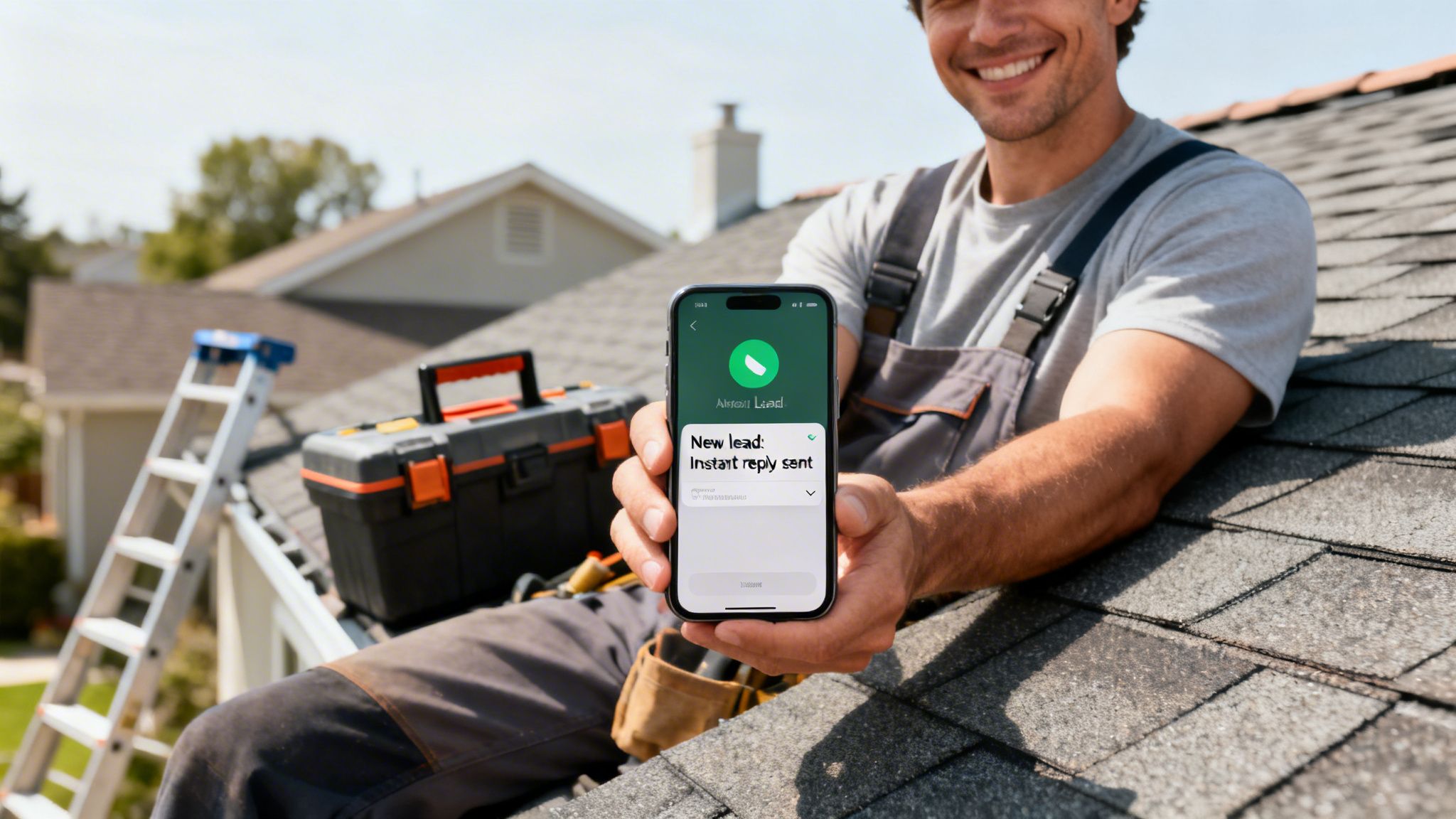
This guide is your straightforward plan for putting marketing automation to work. We’re cutting out the confusing jargon to show you exactly how to capture more qualified leads and win back your time.
The Real Cost of a Slow Response
For local service businesses like yours, speed is everything. When a homeowner has a burst pipe, they’re not just calling one plumber; they’re calling three or four. The first one to give them a confident, professional response almost always gets the job. Trying to do this manually is a losing battle.
A lead that receives a response within five minutes is 21 times more likely to convert than one that has to wait 30 minutes. In this business, if you’re not first, you’re last.
This is precisely where automation becomes your most valuable employee. It never takes a lunch break, gets stuck in traffic, or misses a call. It guarantees every person who reaches out gets an immediate, professional reply, day or night.
What This Guide Will Show You
This is a no-fluff playbook built for service business owners like you. Our approach is all about practical strategies that drive real revenue, not just create more busywork. We've got more tips on our blog about lead generation for small business, but here's what we’ll walk through:
- High-Impact Workflows: Specific, automated sequences for instant lead follow-up, smart appointment reminders, and getting more 5-star reviews.
- The Right Tools: How to pick affordable, easy-to-use software that’s actually built for contractors, not giant corporations.
- A Simple Roadmap: A step-by-step process to get your first automation up and running this week.
It's time to build a reliable system that turns online interest into booked jobs.
What Marketing Automation Actually Means For Your Business
Let's cut right to it. Marketing automation isn’t some far-off concept about robots running your company. It’s simply smart software that takes care of the repetitive, time-consuming tasks bogging you down—the stuff that pulls you away from the real, money-making work.
Think of it as the most dependable employee you could ever hire. This employee never gets tired, never calls in sick, and never, ever forgets to follow up with a new lead.
For an HVAC company in Tampa, that means the moment a homeowner fills out your “Request a Quote” form, a text message is already on its way to them. For a St. Pete realtor, it’s an automatic email sequence that keeps you top-of-mind with past clients. It puts your communication on cruise control, ensuring every potential customer gets a fast, professional touchpoint.
From Corporate Luxury To Main Street Essential
Not too long ago, this kind of tech was only for huge corporations with bottomless marketing budgets. If you didn't have a dedicated IT team, you were out of luck. Thankfully, that’s all changed. These tools are now affordable, easy to use, and built for the needs of local businesses.
Marketing automation is the great equalizer. It lets a solo roofer or a small dental practice deliver a customer experience that can rival—and often beat—larger competitors who are still stuck doing everything the old, manual way.
Small and medium-sized businesses are jumping on this trend. It's projected that by 2026, 76% of all businesses will be using some form of marketing automation. A landscaper in Clearwater can now tap into the same powerful systems as a national franchise, no massive budget required. You can see the full breakdown of these marketing automation statistics to understand just how common this has become.
How It Works In The Real World
Under the hood, marketing automation runs on simple "if-then" recipes. If a customer takes a specific action, then the system automatically triggers a response you've already planned out.
-
IF a new lead finds you on Google Business Profile after hours…
-
THEN they instantly get a text: "Hi [Name], thanks for contacting Clearwater Cooling & Heating! We're closed now, but our team will call you first thing tomorrow morning to schedule your A/C diagnostic."
-
IF you just finished a roofing job…
-
THEN the system waits three days and sends an email automatically asking for a Google review.
It isn't just about blasting out messages. It’s about delivering the right message at the right time. To really grasp how this can reshape your business, it’s worth exploring how effective small business marketing automation truly is.
This system is your 24/7 engine for capturing leads, building trust, and driving revenue—all while you focus on running the business. This is why we also explore related topics like demystifying AI in marketing, so you can see how these modern tools work together.
Five Automation Workflows That Drive Real Revenue
Let's move past the theory and get straight to what actually makes you money. The real magic of marketing automation happens when you build specific systems that run on their own, turning prospects into paying customers.
If you only set up five automated workflows, make them these five. Each one is designed to plug a major leak in the typical service business sales process.
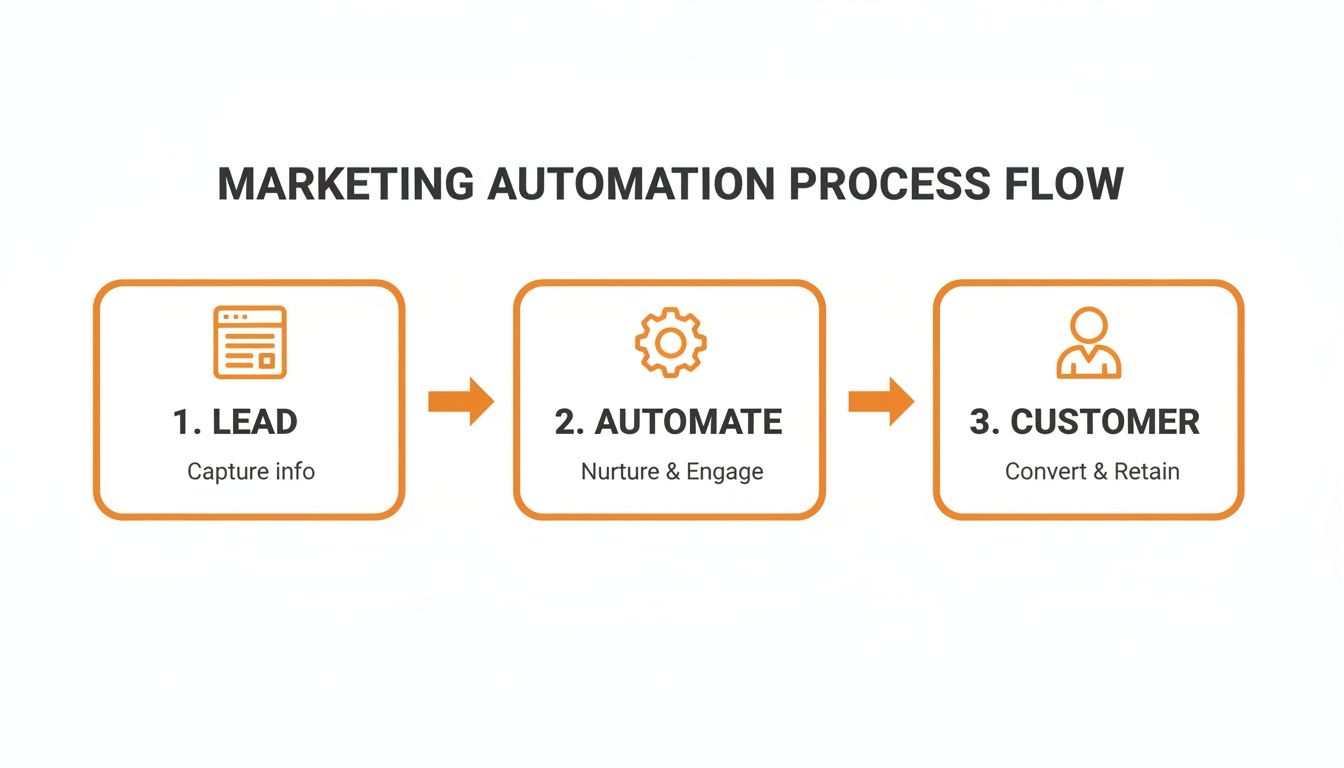
1. The Instant Lead Response
This is the most critical workflow you will ever build. When a homeowner in St. Pete has a leaking pipe, they're reaching out to three or four plumbers at once. The first one who responds professionally almost always wins the job. This workflow ensures you’re always first.
- Trigger: A potential customer fills out a contact form on your website.
- Action 1 (Instantly): An SMS text is sent: "Hi [Lead Name], this is John from Clearwater Plumbing. Thanks for reaching out! I'm reviewing your request for a water heater repair and will call you in the next 5-10 minutes from this number."
- Action 2 (Instantly): An email confirms their submission and sets expectations.
- Action 3 (1 Minute Later): You or your office manager get an internal notification with the lead's details, ready for the callback.
This single automation closes the gap between someone showing interest and having a real conversation, dramatically increasing your chances of booking the job.
2. The Smart Nurturing Sequence
What about the leads who aren't ready to buy right now? The ones just getting quotes for a kitchen remodel or researching a new A/C unit. A nurturing sequence keeps you top-of-mind so when they are ready, you’re the only one they call.
Companies that nurture leads with marketing automation experience a 451% increase in qualified leads. The data doesn't lie—this is where the real growth happens.
Here’s a simple nurturing workflow for a local painting contractor:
- Day 3: An email with a link to your project gallery, showing off your best work in the Tampa Bay area.
- Day 10: An email with a powerful case study or a testimonial from a happy client in their neighborhood.
- Day 25: A final, helpful email offering "3 Things to Ask Before Hiring a Painter."
This sequence builds trust and authority over time. All you have to do is set it up once. An effective content generation strategy is the perfect fuel for these emails.
3. The No-Show Eliminator
For any service business, no-shows are poison. They waste your time and cost you real money. An appointment reminder workflow practically eliminates them. It’s incredibly simple but profoundly effective.
- Trigger: An appointment is booked in your calendar.
- Action 1 (24 Hours Before): An automated email reminder goes out with the date, time, and location, including links to easily confirm or reschedule.
- Action 2 (2 Hours Before): A simple text message gives them a final nudge: "Hi [Client Name], just a friendly reminder of your dental cleaning with Dr. Smith at our Clearwater office today at 2:00 PM. We look forward to seeing you!"
This two-step process reinforces the appointment and gives clients a frictionless way to communicate if their plans change, which means your no-show rate plummets.
4. The 5-Star Review Machine
In 2024, your Google reviews are one of your most powerful marketing assets. More 5-star reviews mean higher visibility in local search and more trust from prospects. This workflow automates the awkward process of asking for them.
- Trigger: You mark a job as "Completed" in your system.
- Action 1 (1 Day Later): An email is sent: "Hi [Client Name], thank you for choosing us! Would you mind taking 30 seconds to leave us a review on Google? It helps our local business tremendously."
- Action 2 (3 Days Later): If they haven’t clicked the link, a follow-up text provides a direct, one-tap link to your Google review page.
This turns your satisfied customers into a predictable engine for building a stellar online reputation.
5. The Customer Reactivation Campaign
Why spend all your time and money chasing brand-new customers when you have a goldmine in your existing client list? A reactivation campaign automatically reaches out to past clients who haven't booked with you in a while, perfect for any business with recurring services.
- Trigger: It has been 12 months since a client's last service date.
- Action (Automatic): An email is sent with an exclusive offer: "Hi [Client Name], it's been a while! As a thank you for being a loyal customer, here is 10% off your next annual HVAC tune-up. Book by the end of the month to claim your discount!"
This workflow transforms your past customer list into a reliable source of predictable, recurring revenue.
How To Choose The Right Automation Software
Not all marketing automation software is built the same. A lot of platforms are bloated with features you’ll never touch and are designed for massive corporations—not a local Tampa Bay plumbing company.
Choosing the wrong system is worse than having no system at all. As a service business owner, you don't need a thousand bells and whistles. You need a handful of powerful features that directly lead to more booked jobs.
The Non-Negotiable Features For Service Businesses
When you look at different platforms, ignore the flashy demos and focus on what will actually move the needle for your business. If a tool doesn’t have these core components, walk away.
- A Unified Communications Inbox: You need one single place to see and reply to every text, email, Facebook message, and Google Business Profile chat.
- A Simple Workflow Builder: The system should have a simple, visual, drag-and-drop builder. If you can't map out an instant response in a few clicks, the tool is too complicated.
- Native Google Business Profile Integration: The software must connect directly to your GBP, letting you automate responses to messages and trigger review requests.
- Built-In Reputation Management: The system needs to track your star ratings, notify you of new reviews, and give you one dashboard to respond from.
If a salesperson starts talking about complex analytics before confirming these four basics, it’s a huge red flag.
All-In-One Platform Vs. Piecing Tools Together
You have two options: get an all-in-one platform or try to stitch together a bunch of separate tools. For a service business, the choice is clear.
An all-in-one platform is almost always the better choice. It saves you money, eliminates technical headaches, and gives you a single source of truth for all your customer interactions.
When you piece different tools together, you create data silos. As soon as one tool updates, it can break the connection to another, and your automations grind to a halt. An integrated platform prevents this. As you weigh your options, look at guides on essential software for small businesses and how systems fit into a bigger strategy to work smarter with AI marketing tools to get time back in your day.
Your Step-By-Step Implementation Roadmap
Alright, let's get this done. You need a practical, straightforward plan. This is your blueprint.
Step 1: Choose The Right Tool Without Overpaying
First, pick your software. You need a system built for service businesses that pulls all essential tools into one affordable package.
Platforms like HighLevel (which we use at Spark Hive) are perfect because they bundle a unified inbox, SMS/email automation, review management, and a simple workflow builder. This all-in-one approach saves you money and the headache of taping separate apps together. For more ideas, check out our post on how to work smarter, not harder with AI tools.
Step 2: Map Your First Workflow
Don't try to automate everything at once. Start with the one thing that will deliver the fastest return: instant lead response. Speed-to-lead is king.
- The Trigger: A new lead fills out the contact form on your website.
- First Action: The system instantly sends an SMS to that lead confirming their request and letting them know you'll be calling in minutes.
- Second Action: At the same time, send an email that mirrors the text. It's a great place to link to your main pillar page so they can learn more.
- Internal Alert: Have the system send an immediate notification—via text, email, or a push alert—to you or your office manager with the lead's details.
This sequence guarantees you're the first to reach out, giving you a huge leg up on slower competitors.
Step 3: Integrate With Your Website and Lead Sources
Your new automation software is useless if it isn’t talking to your lead sources. The next step is to connect your system to your website, your Google Business Profile, and any other platform that sends you customers.
Your website's contact form is your digital front door. Integrating it with your automation platform is non-negotiable. It’s the difference between a lead sitting in an inbox for hours and getting a text from you in seconds.
This sounds more technical than it is. Most platforms give you a simple code snippet to paste or a direct integration that connects with a few clicks. For instance, a real estate agent in Clearwater could connect their "Schedule a Showing" form so every submission kicks off an automated follow-up. Getting this integration right is also vital for your content generation strategy, as it allows you to see which content brings in leads.
Step 4: Launch, Test, And Measure
With everything connected, it’s time to go live. But don't just set it and forget it. The final step is to test and measure what’s happening.
Run a test submission through your website form yourself. Did the text come through? Did the email land in your inbox? Fix any glitches now, before real leads are on the line.
Once you're live, keep a close eye on a few key numbers:
- Contact Rate: How many new leads are you actually getting on the phone? This number should jump up significantly.
- Booking Rate: What percentage of those contacted leads turn into scheduled jobs?
- Revenue: Are you seeing a direct, measurable increase in business?
Tracking these metrics shows you what your marketing automation for small business is doing for your bottom line, turning marketing from a guess into your most powerful investment.
Frequently Asked Questions
1. Is marketing automation too expensive for my small business?
No. A few years ago it was, but today's platforms are built for small businesses and are incredibly affordable. The real cost is missing one big job because you couldn't get back to the lead fast enough. That one lost job often costs more than a full year of the software. It’s an investment that pays for itself quickly.
2. How much time does this take to set up?
The whole point of automation is to give you time back, not take more of it. There's some thinking required upfront to map out your follow-up, which an agency can handle for you. After that, your day-to-day involvement is minimal. Most of our clients reclaim 5-10 hours a week almost immediately.
3. Will this feel robotic to my customers?
No. Good automation isn't robotic; it's about being instantly responsive and consistently helpful. An automated, personalized text that hits a customer's phone in 30 seconds feels far more professional than a voicemail from you six hours later. It shows you’re on the ball and ready to solve their problem.
4. What's the very first automation I should set up?
The Instant Lead Response workflow. Speed-to-lead is everything for a local service business. An immediate text message and email that go out the second someone fills out your website form will give you the biggest and fastest return on your investment. Start there.
5. What if I'm not technical? Can I still do this?
Absolutely. Modern automation tools are built for business owners, not developers. They use simple, visual "drag-and-drop" builders. If you can write an email, you can build a workflow. And if you don't want to touch it at all, that's what we're here for. Your focus should be on your trade, not on becoming a tech expert.
Ready to stop juggling leads and build a system that brings in predictable work? We build these exact systems for local service companies across Tampa Bay every day.
Book a no-obligation strategy call at sparkhive.agency and let’s finally make your marketing work for you.
Related resources for Tampa Bay business owners


You May Also Like

Small Business Website Design Services That Work

Stop Wasting Time on Social Media: AI Automation for Your Tampa Business